What Are Media Intelligence Tools? How Real-Time PR Intelligence Protects Brand Reputation
Austin, United States – March 3, 2026 / Handraise Inc /
Key Takeaways
Real-time media intelligence tools are reshaping how communications teams protect and grow brand reputation—and the gap between teams who adapt and those who don’t is widening fast.
-
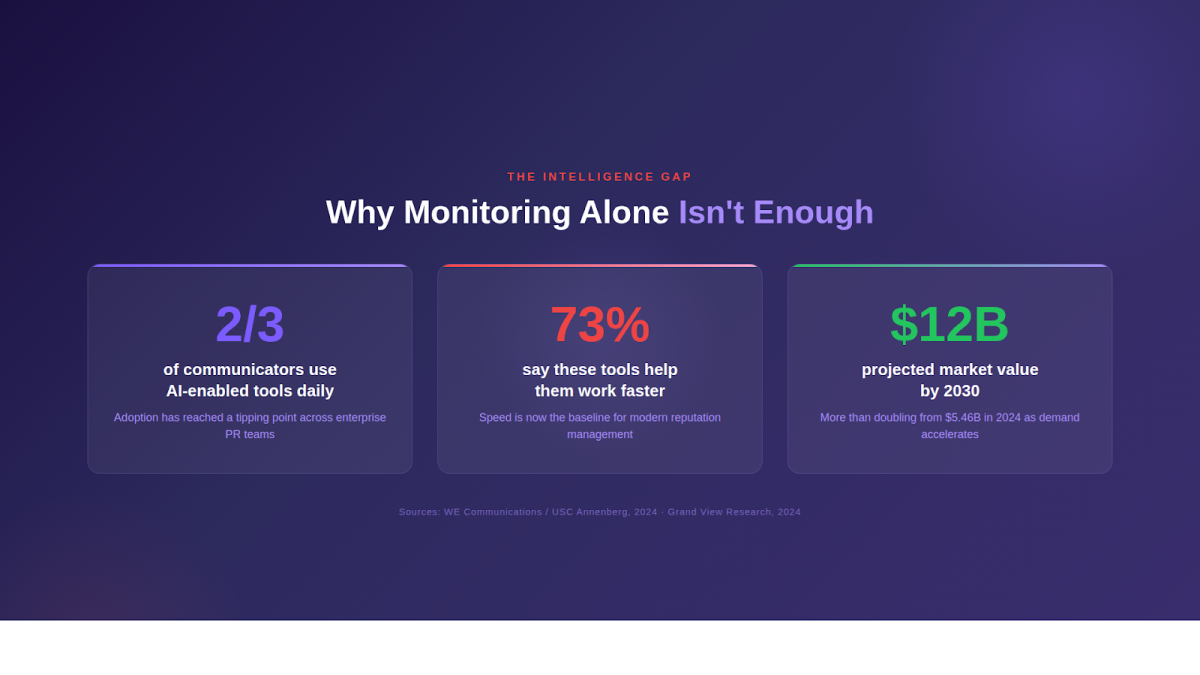
The global media monitoring tools market reached $5.46 billion in 2024 and is projected to more than double by 2030, driven by demand for real-time analytics and AI-powered brand reputation tracking.
-
Two-thirds of communicators now use AI-enabled tools frequently, with 70 percent reporting improved work quality and 73 percent saying these tools help them work faster—signaling a permanent shift in how PR teams operate.
-
Legacy approaches relying on Boolean searches and quarterly reporting leave brands blind to narrative shifts that can define—or destroy—reputation in hours, not months.
-
The next generation of media intelligence tools goes beyond counting mentions to identify narrative patterns, measure brand-centric sentiment, and track how AI systems describe your brand.
If your communications team is still waiting for quarterly reports to understand market perception, you’re already behind. The shift to real-time intelligence isn’t optional—it’s overdue.
Every communications leader has lived this moment: the quarterly media report finally lands, weeks after it was relevant, and the narratives it describes have already evolved beyond recognition. The data is technically accurate. It’s also functionally useless.
This isn’t a minor inconvenience—it’s a structural failure in how most organizations approach brand reputation monitoring. And it’s one of the core reasons media intelligence tools have moved from “nice to have” to mission-critical for enterprise PR teams. According to a survey of over 600 communications professionals by WE Communications and USC Annenberg, two-thirds of communicators now use AI-enabled tools frequently, with 73 percent reporting these tools help them work more quickly.
The question is no longer whether PR teams need real-time media monitoring. It’s whether the tools they’re using actually deliver intelligence—or just more noise.
What Makes Media Intelligence Tools Different from Basic Monitoring?
Media monitoring and media intelligence are often used interchangeably, but they represent fundamentally different capabilities. Understanding the distinction is the first step toward building a comms function that operates at the speed of reputation.
Monitoring Tracks Mentions. Intelligence Reveals Meaning.
Traditional media monitoring does exactly what it sounds like: it tracks where and when your brand is mentioned across media channels. You get a list of clips, a volume count, and maybe some rudimentary sentiment tagging. The output is descriptive—it tells you what happened.
Media intelligence tools layer analysis, context, and pattern recognition on top of that raw data. Instead of reporting that your brand received several hundred mentions, intelligence reveals how those mentions connect to specific narrative themes, whether those narratives are gaining or losing traction, and how your brand’s position compares to competitors within those story arcs.
Why the Gap Matters More Than Ever
The reason this distinction matters more today than five years ago comes down to speed and complexity. Media cycles no longer operate on a 24-hour news cadence. A story can surface on social media, gain mainstream traction, and shift public perception within hours. Narrative intelligence that identifies emerging storylines before they solidify gives communications teams the lead time they need to respond strategically rather than reactively.
|
Capability |
Basic Monitoring |
Advanced Intelligence Platforms |
|
Coverage tracking |
Keyword and Boolean-based alerts |
AI-driven feed building with automatic enrichment |
|
Sentiment analysis |
Generic positive/negative/neutral |
Brand-centric sentiment tied to specific narratives |
|
Competitive insight |
Mention volume comparison |
Dynamic share of voice across narrative themes |
|
Reporting speed |
Weekly or quarterly summaries |
Real-time dashboards with prioritized signals |
|
Narrative context |
Individual clips without connection |
Clustered coverage showing story-level patterns |
|
AI perception tracking |
Not available |
Monitoring how LLMs describe and cite your brand |
How Are PR Teams Using Real-Time Media Monitoring to Protect Reputation?
The practical applications of real-time media monitoring extend beyond faster alerts. When intelligence is truly real-time, it transforms how a communications team operates.
Crisis Detection Before the Crisis
Most crisis communications plans assume the crisis has already arrived. Real-time media intelligence tools shift that timeline. By tracking narrative velocity—how quickly a story is gaining traction across outlets and social channels—teams can identify potential reputation threats while they’re still forming.
This isn’t about monitoring for negative mentions. It’s about recognizing when a specific narrative pattern begins clustering around your brand in a way that signals escalating risk. A single negative article might warrant monitoring, but a cluster of coverage coalescing around a particular theme demands action.
Research from Grand View Research found that brand reputation management represented the largest application segment in the media monitoring industry in 2024, with organizations increasingly investing in platforms that detect emerging threats and sentiment shifts before they escalate.
Campaign Measurement in Real Time
Traditional campaign measurement follows a painfully slow cycle. A campaign launches, coverage accumulates over weeks, and the team eventually compiles a retrospective report. By the time results are in, the opportunity to optimize messaging mid-campaign has passed.
Real-time PR intelligence changes this dynamic. Communications teams can observe how campaign narratives land, which messages resonate with specific audiences, and where coverage gaps exist—all while the campaign is still active. That feedback loop allows for mid-course adjustments that would be impossible with legacy reporting timelines.
When a CCO can walk into a leadership meeting with current narrative positioning data rather than month-old clip counts, the entire perception of the communications function changes. PR intelligence delivered in real time earns credibility that retrospective reports never will.

What Role Does AI Play in Modern Media Intelligence?
Artificial intelligence has become inseparable from the concept of media intelligence. But not all AI applications deliver equal value, and understanding where AI genuinely advances intelligence—versus where it adds complexity without insight—is essential.
From Boolean to Intelligent Feed Building
For decades, media monitoring relied on Boolean search queries. Anyone who has built and maintained Boolean strings knows the limitations: they require constant tuning, miss contextually relevant coverage that doesn’t match exact patterns, and generate significant noise alongside legitimate results.
AI-powered intelligence platforms replace this approach with intelligent feed building that analyzes incoming content for relevance, tags it for brand prominence, and enriches it with publication authority data and social engagement metrics. The result is a feed that surfaces what matters rather than everything that matches a keyword string.
Sentiment That Actually Understands Your Brand
Generic sentiment analysis has been a staple of media monitoring for years, but its limitations are well documented. Classifying a mention as “positive” or “negative” without understanding the specific context of your brand produces unreliable insights.
Brand-centric sentiment analysis represents a meaningful evolution. Rather than applying generic NLP across all mentions, advanced intelligence platforms evaluate sentiment through the lens of what matters specifically to your brand. A mention that might register as neutral in generic analysis could carry significant implications when evaluated against your brand’s specific narrative position.
The LLM Factor: AI as an Audience
Here’s a dimension that most legacy tools ignore entirely: AI systems are now an audience for your brand. When someone asks ChatGPT, Perplexity, or Google’s AI Overview about your industry, those responses are shaped by earned media. The narratives that dominate your coverage don’t just influence human readers—they influence the AI systems that millions now consult for recommendations.
Monitoring how LLMs perceive and describe your brand is no longer a futuristic concept. It’s a present-tense capability that forward-thinking communications teams are already leveraging.
5 Capabilities That Define Best-in-Class Intelligence Platforms
Not every platform marketed as “media intelligence” delivers true intelligence. Here’s what separates the platforms that transform communications strategy from those that simply add a dashboard to old-school monitoring.
1. Narrative Clustering Grouping related coverage into narrative themes rather than treating each mention as an isolated data point. This is the foundation of story-level intelligence—understanding how individual articles form the larger narratives shaping perception.
2. Real-Time Narrative Velocity Tracking Measuring not just what narratives exist, but how quickly they’re gaining or losing momentum. This provides early warning on emerging reputation risks and helps teams prioritize response efforts.
3. Dynamic Share of Voice Moving beyond simple mention volume comparisons to measure competitive positioning within specific narrative contexts. Your share of voice in a sustainability conversation is fundamentally different from your overall mention volume.
4. Publication Tiering and Brand Prominence Scoring Automatically ranking coverage by publication authority and reach, combined with analysis of whether your brand appears in the headline or as a passing reference. Not all coverage carries equal weight.
5. LLM Perception Monitoring Tracking how AI systems present your brand in generated responses, including the narratives and sources they cite. AI is now a critical channel for brand perception.
|
Capability |
What It Replaces |
Strategic Outcome |
|
Narrative clustering |
Isolated clip counting |
Story-level reputation visibility |
|
Velocity tracking |
Delayed quarterly reports |
Early crisis detection |
|
Dynamic share of voice |
Raw mention volume |
Competitive positioning by theme |
|
Publication tiering |
Equal-weight clip lists |
Focus on high-impact coverage |
|
LLM monitoring |
No visibility into AI perception |
Brand accuracy across AI channels |
How Does Media Intelligence Impact Brand Reputation Monitoring Long-Term?
The long-term strategic value of these platforms extends well beyond daily operations. When communications teams have access to continuous, narrative-level intelligence, it changes the conversations they’re able to have with the C-suite and the board.
From Reporting Function to Strategic Advisor
One of the most persistent challenges for communications leaders is proving strategic value. When the primary output is a clip report with volume counts and vague sentiment scores, demonstrating how comms efforts connect to business outcomes is nearly impossible. Yet a Ragan Communications and HarrisX survey of 400 senior-level communicators and CEOs found that 83 percent of CEOs say they value the communications function “very much”—the disconnect lies not in perceived importance but in the ability to demonstrate strategic impact with data.
When a VP of Communications can show that a coordinated media strategy shifted the dominant narrative around a product launch, moved dynamic share of voice in a key competitive category, or preempted a reputation risk identified through narrative velocity tracking, the function moves from reporting to advising. That shift separates a communications team that defends its budget from one that expands it.
Building a Narrative Strategy, Not Just a Media List
Most communications teams plan their earned media strategy around outlet targets and journalist relationships. Those fundamentals still matter. But without intelligence about which narratives are active, which are emerging, and where the brand currently sits within them, media relations becomes a scattershot effort.
Reputation engineering—the deliberate shaping of the narratives that define your brand—requires a foundation of real-time narrative intelligence. You can’t engineer outcomes you can’t observe.
Frequently Asked Questions About Media Intelligence
How quickly can intelligence platforms show value compared to basic monitoring?
Most teams see an immediate difference in signal quality—less noise, more relevant coverage, and narrative-level context. Strategic value, such as identifying narrative trends that inform campaign decisions or preempting reputation risks, typically becomes clear within the first 30 to 60 days. Intelligence platforms deliver insight from day one, while basic monitoring requires manual interpretation most teams don’t have capacity to perform.
What’s the difference between narrative intelligence and traditional sentiment analysis?
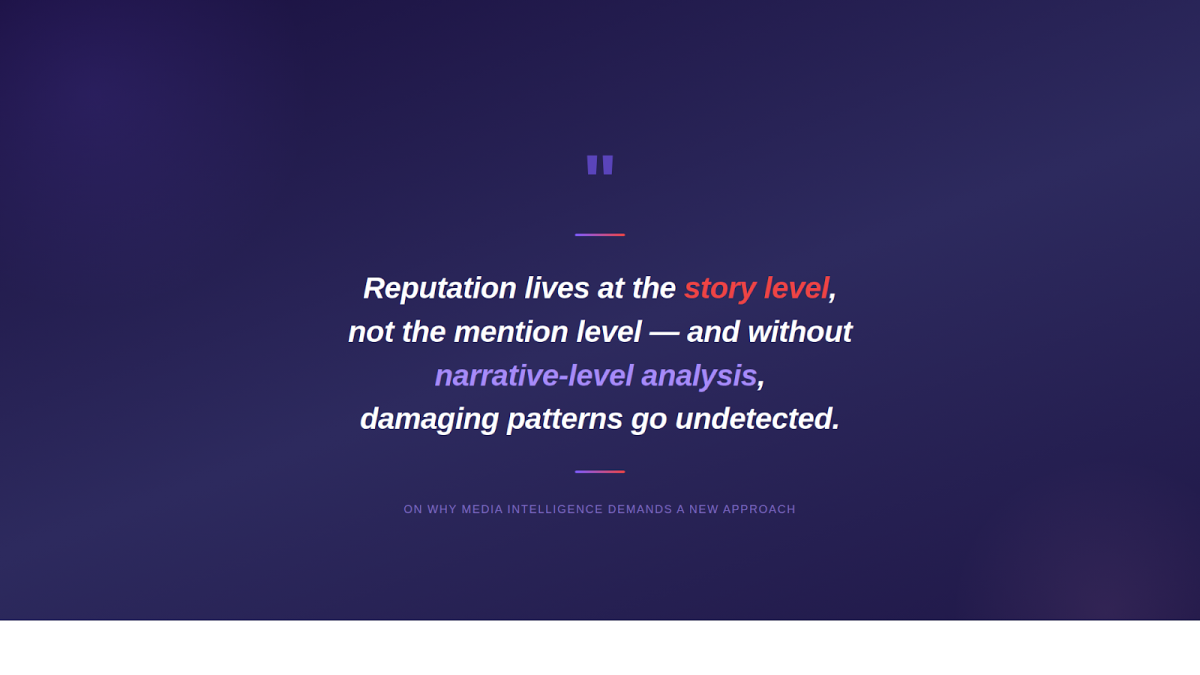
Traditional sentiment analysis classifies individual mentions as positive, negative, or neutral. Narrative intelligence examines how mentions connect to larger stories forming around your brand—revealing themes and storylines shaping perception over time. Reputation lives at the story level, not the mention level. A cluster of technically “neutral” articles can collectively construct a damaging narrative, and without narrative-level analysis, that pattern goes undetected.
Do these platforms replace the need for human PR judgment?
No. The most effective platforms augment human capability rather than replace it. They handle data processing and pattern recognition that would overwhelm any team’s manual capacity. Strategic interpretation—what insights mean for your brand and what actions to take—remains a human function. The goal is freeing communications professionals from data gathering so they can focus on strategic work.
How do modern platforms account for AI-generated search results?
Forward-looking platforms analyze how brands appear in AI-generated content—including responses from ChatGPT, Perplexity, and AI-powered search features. Every time an AI system answers a question about your industry, it draws on the earned media landscape. The narratives dominating your coverage directly influence how AI describes your brand to millions of users.
Ready to Move from Monitoring to Intelligence?
The transition from basic media monitoring to true PR intelligence isn’t a luxury—it’s the competitive baseline for communications teams that want to operate at the speed of reputation. Real-time brand reputation monitoring, narrative-level analysis, and LLM perception tracking represent the new standard for enterprise communications.
The brands that will lead their categories aren’t the ones with the most mentions. They’re the ones that understand, shape, and optimize the narratives defining how they’re perceived—by human audiences and AI systems alike. Handraise was built from the ground up to deliver exactly this kind of next-generation narrative intelligence. If your team is ready to move beyond counting clips and start engineering reputation, book a demo and see the difference real-time media intelligence tools can make.


Contact Information:
Handraise Inc
1135 W 6th St., Suite 110A
Austin, TX 78703
United States
Matt Allison
https://www.handraise.com/