
Key Takeaways
- The average employee spends roughly 25% of their workweek on repetitive tasks that AI can handle – that is 10+ hours gone every single week.
- Most businesses skip the discovery phase entirely and jump straight to buying tools, which is why so many AI projects fail to deliver real savings.
- Workers using AI tools report weekly time savings ranging from 2.2 hours at baseline to 4+ hours for daily users, with some organizations reporting even higher gains depending on deployment depth.
- Inefficiency from manual processes can silently drain 20-30% of annual revenue, yet most teams never trace the source.
- DaMo Digital’s AI Efficiency Sprint helps SMBs pinpoint and automate their biggest time-wasters within 14 days, turning lost hours into measurable ROI.
The hours are already there. They are buried inside email chains, copy-paste routines, and answer-the-same-question-again moments. The challenge is not finding AI tools – it is knowing where to point them.
Your Team Is Losing 25% of Their Week to Tasks AI Can Handle
The average employee spends approximately 25% of the workweek on repetitive administrative tasks that artificial intelligence can automate. Emails, document creation, manual data entry, repetitive customer questions and internal follow-ups quietly consume more than ten hours every week for many employees.
Across a team of five people, that represents over fifty hours of lost productivity every week. Most businesses never notice this hidden cost because these activities have gradually become part of daily operations.
Generative AI has changed what is possible. Research shows employees already save several hours every week by using AI tools, while businesses implementing structured AI workflows achieve significantly larger efficiency gains. The real challenge is no longer finding AI software—it is identifying where AI will create the greatest business impact.
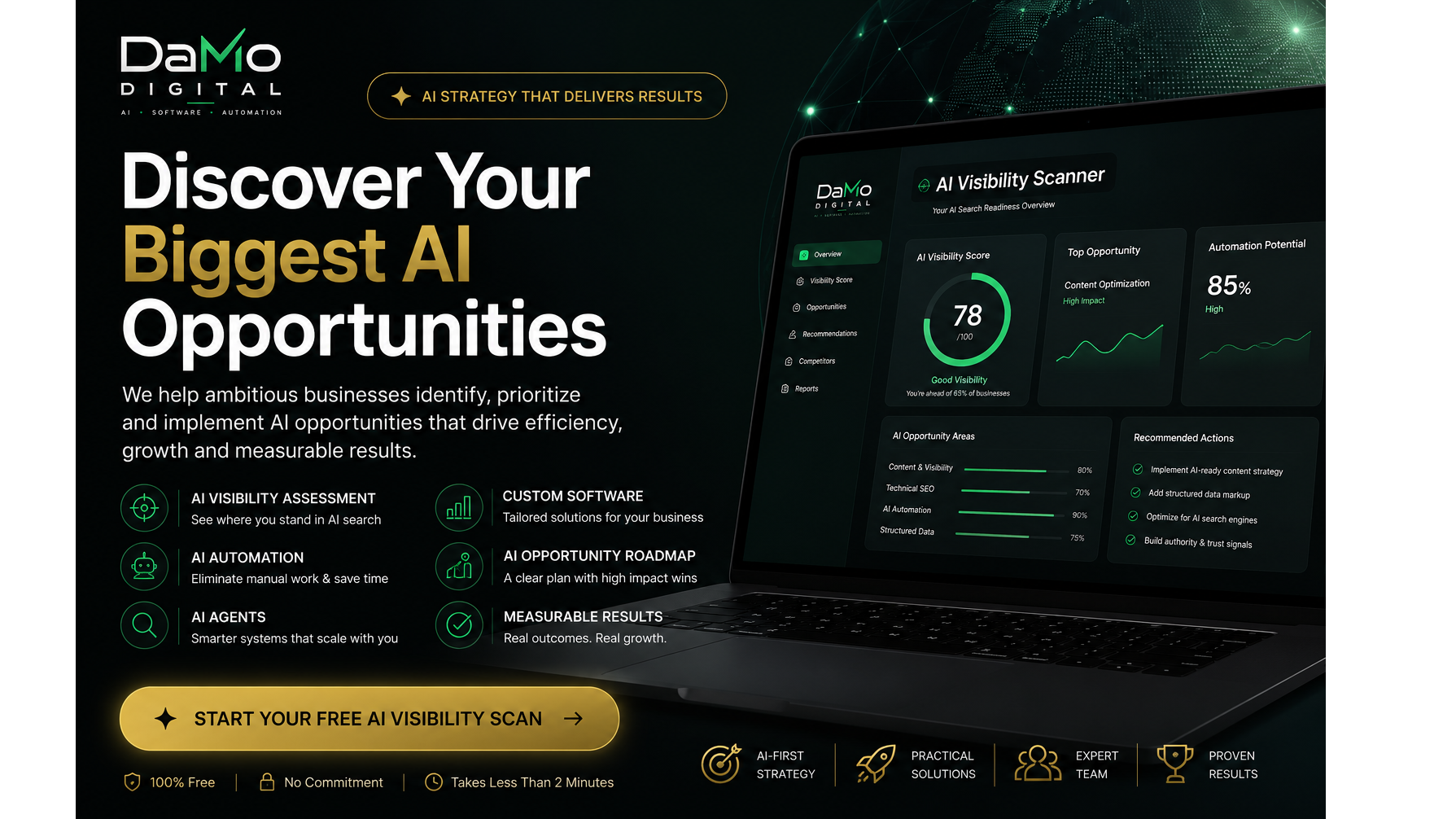
This is exactly why DaMo Digital developed the AI Efficiency Sprint™ and the AI Visibility Scanner. Rather than starting with software, every project begins by discovering where businesses lose time, where automation creates measurable value and how AI can strengthen both operational efficiency and online visibility.
Why Most Businesses Never Find Their Real Time-Wasters
Technology First Is Usually the Wrong Decision
Many organisations begin their AI journey by purchasing software before understanding their existing processes. Teams experiment with ChatGPT, Microsoft Copilot or other AI platforms expecting immediate improvements, only to discover months later that little has changed.
The software is rarely the problem.
The real issue is that inefficient workflows were automated before they were properly understood.
Successful AI adoption starts with business discovery—not software selection.
Where Businesses Typically Bleed Hours
Repetitive Emails and Document Handling
Answering the same client question for the twentieth time. Generating a quote using last month’s template. Reformatting a supplier document so it fits an internal system. These tasks feel minor in isolation – and that is exactly why they never get addressed. In aggregate, they account for a significant slice of the weekly workload for most service-based businesses.
Manual Data Entry and Internal Follow-Ups
Data entry is one of the clearest automation targets available. Even modest automation of routine data entry tasks can return meaningful hours each month – and as the volume and complexity of automated operations grows, so do the savings. For many SMBs, reclaiming that time is the equivalent of getting a full work week back every month.
Internal follow-ups carry a similar cost. When team members spend time chasing project status, payment confirmations, or document approvals, that is coordination overhead that scales badly as businesses grow.
Scattered Information and Same-Question Loops
When information lives in different places – inboxes, spreadsheets, shared drives, someone’s memory – teams spend real time just finding answers. Staff field the same internal questions repeatedly because there is no single source of truth. This creates same-question loops where institutional knowledge gets re-explained instead of systematized. For most SMB environments, it is one of the highest-friction, lowest-visibility time drains that exists.
The DaMo Discovery Framework™
Every AI project at DaMo Digital starts with one simple philosophy:
Discovery before Implementation™
Instead of immediately recommending software, every engagement begins by answering three essential questions.
Where does valuable time disappear?
Which repetitive processes create the biggest operational bottlenecks?
Which activities add little value but consume significant staff capacity?
Only after these questions have been answered does automation begin.
This discovery-first methodology consistently uncovers between 10 and 20 hours of potential weekly time savings for many service businesses. It also prevents organizations from investing in AI solutions that automate inefficient or unnecessary workflows.
Rather than guessing where AI might help, businesses receive a prioritized roadmap based on measurable business impact.
The AI Efficiency Sprint™
Unlike traditional AI consulting projects, the AI Efficiency Sprint™ follows a structured fourteen-day implementation methodology designed specifically for small and medium-sized businesses.
Every Sprint begins with discovery before any technology recommendations are made.
Businesses receive:
- AI Efficiency Scan™
- AI Efficiency Score™
- AI Efficiency Blueprint™
- Prioritised Automation Roadmap
- Estimated Weekly Time Savings
- Quick Wins
- Live Strategy Session
- First AI Implementation
- Team Training
- 30 Days Support
Instead of delivering lengthy reports filled with theoretical recommendations, the Sprint concludes with a working AI solution that immediately starts creating measurable business value.
20-30% of Revenue Lost to Manual Processes
Inefficiency from manual processes is not just a time problem. Research indicates that companies can lose between 20% and 30% of annual revenue to manual processes – not through obvious failures, but through accumulated friction: slow turnaround times, re-work from human error, missed follow-ups, and staff time spent on low-value tasks instead of client-facing work.
Companies using AI typically achieve productivity gains of 20-25%, with projections of up to 40% improvement over the next decade. A Salesforce report found that 91% of SMBs using AI say it boosts their revenue, and 90% report improved operational efficiency. The businesses capturing those gains are not necessarily bigger or better-resourced – they are simply earlier to the discovery step.
AI Visibility Is Becoming Just As Important As SEO
Operational efficiency is only one side of the equation.
Today’s businesses are increasingly discovered through AI assistants including ChatGPT, Claude, Gemini and Perplexity.
If these systems cannot clearly understand what a business does, who it helps and why it deserves authority, they are unlikely to recommend it.
The AI Visibility Scanner evaluates more than thirty technical and content factors that influence AI discoverability, helping businesses understand how visible they are across AI-powered search platforms before implementing improvements.
This creates a unique combination of operational intelligence and AI search visibility—two competitive advantages that are becoming increasingly important for modern service businesses.
Which Businesses Gain the Most From Automation
Service-Heavy SMBs: Accountants, Law Firms, Construction
The highest-impact automation targets tend to share a profile: service businesses where expert staff spend a disproportionate amount of time on administrative work. Accountants processing client documents by hand. Law firms generating routine correspondence. Construction firms chasing approvals, coordinating schedules, and managing supplier follow-ups manually.
AI-powered tools have shown measurable results in service environments – chatbots and automated assistants, for example, have been shown to meaningfully reduce customer response times and improve satisfaction scores without adding headcount. When experts spend less time on coordination and more time on the work only they can do, output quality and capacity both improve.
The common thread is not industry – it is process density. If the business runs on a high volume of repeatable tasks, the automation opportunity is there. Discovery just has to happen first.
Ready to Discover Your Biggest AI Opportunities?
Most businesses already have significant automation opportunities hidden inside their existing workflows.
The challenge is not buying more AI software.
The challenge is discovering where AI will generate the greatest return before making technology decisions.
The free AI Visibility Scanner provides an immediate assessment of how well a business is positioned for AI-powered search platforms.
Businesses looking to uncover operational inefficiencies can begin with the AI Efficiency Scan™, while organisations ready to implement measurable automation can move directly into the AI Efficiency Sprint™.
Learn more:
https://damodigital.nl/ai-visibility-scanner
DaMo Digital
info@damodigital.nl
+31 854862185
70 Benno Premselastraat
Rotterdam
Zuid-Holland
3059 LJ
Netherlands


