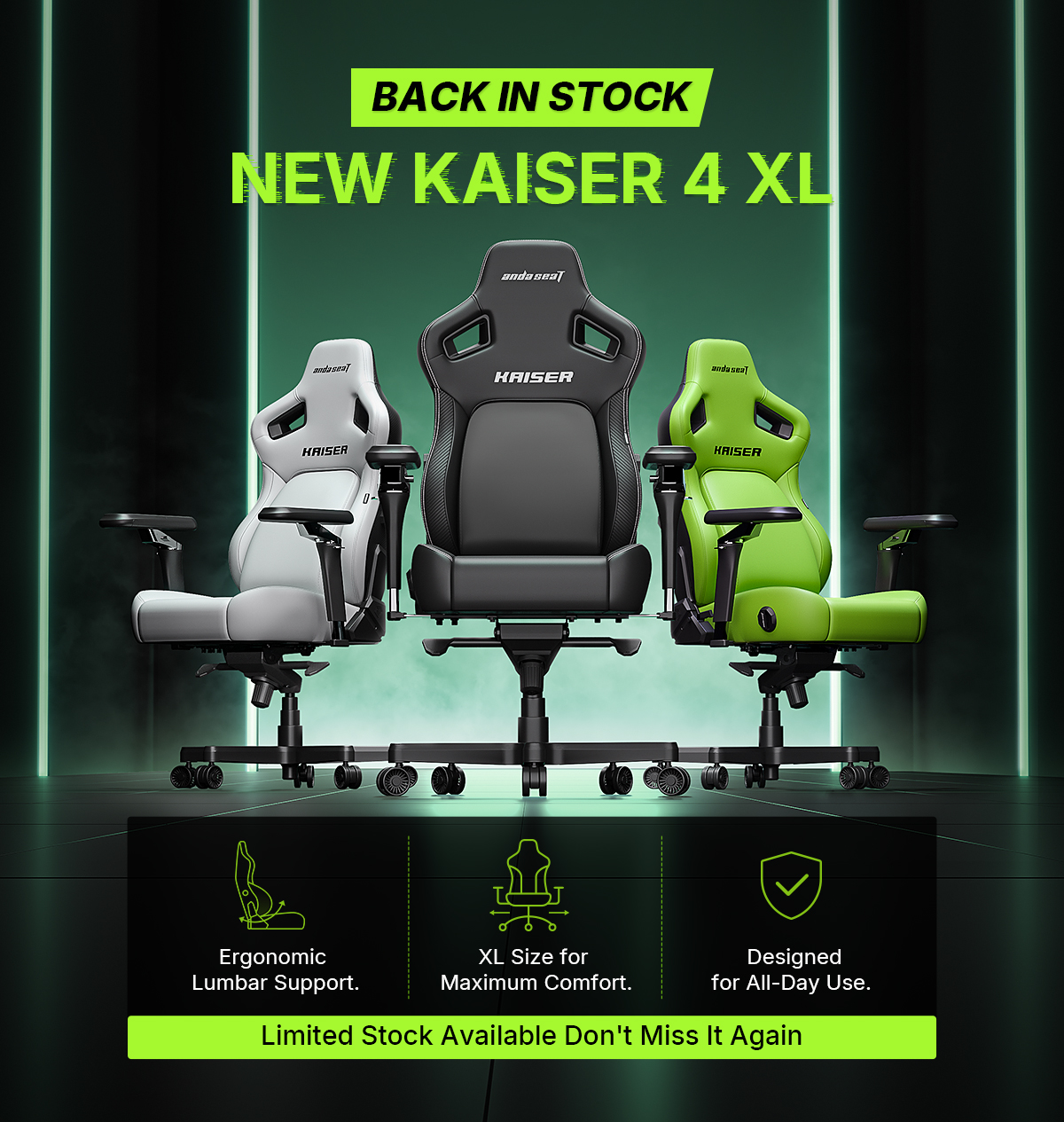
As Smartphone-Heavy Screen Habits Expand, AndaSeat Positions Kaiser 4 Around More Flexible Arm Support
SPOKANE, WA, UNITED STATES, June 22, 2026 /EINPresswire.com/ — AndaSeat is highlighting the Kaiser 4 Series around a consumer issue that has become more visible in modern desk use: many people no longer use one workstation posture for one device alone. Instead, they move between keyboard work, controller use, phone scrolling, messaging, reading, and short-form video consumption throughout the day, often while remaining in the same chair. In that context, arm support is being judged less by whether it exists at all and more by whether it can adapt to different screen habits without forcing the shoulders, elbows, and wrists into repeated compensation.
Recent official data help explain why this question is becoming more relevant. Ofcom’s Online Nation 2025 report says UK adults spent an average of 4 hours 30 minutes online per day in May 2025, up by 10 minutes from the previous year, and that most online time is on a smartphone. Smartphones accounted for the majority of online time for both men and women, while younger adults spent the most time online overall. That does not describe only mobile use on the go. It also reflects a broader shift in everyday screen behavior, where phone use increasingly overlaps with desk-based routines rather than replacing them entirely.
At the same time, public workstation guidance continues to emphasize that upper-body support depends on proper alignment. OSHA’s chair guidance says adjustable armrests should support the lower arms while allowing the upper arms to remain close to the torso and the shoulders to stay relaxed. The same guidance also notes that badly positioned armrests can interfere with chair placement and increase reaching and leaning, which can fatigue the lower back, arm, and shoulder. HSE’s display screen equipment guidance similarly advises workers to keep shoulders relaxed, position the keyboard just below elbow height, and keep the mouse in line with the elbow.
For consumers, this creates a new pain point. Traditional armrest logic often assumes the user is sitting squarely in front of a keyboard for most of the session. But desk behavior is increasingly less singular than that. A person may type for part of the day, then turn slightly to answer messages on a phone, watch a video, use a handheld device, or lean into a controller-based posture later in the evening. When the chair’s arm support cannot follow those changes, the burden often shifts back to the shoulders and forearms.
AndaSeat said the Kaiser 4 Series was developed in response to that kind of multi-device routine. The company is positioning its 6D armrest system not as an isolated premium feature, but as an answer to the growing mismatch between traditional chair armrests and today’s more fragmented desk behavior.
Why Mobile-First Screen Habits Are Changing Chair Expectations
The rise in smartphone-heavy online time has changed how a workstation is used even when the user remains seated at a desk. Phone-based tasks tend to shift the elbows, rotate the forearms, and alter the width and angle of arm support compared with standard keyboard-and-mouse use. The same is true when users move from PC work to console play or to passive viewing with a device in hand. This does not mean desktop use is disappearing. It means chair design has to account for more transitions between device modes in the same session.
This is where adjustable armrests become more relevant than before. OSHA’s guidance says armrests should be close enough to support the lower arms while keeping the upper arms close to the body and low enough to keep the shoulders relaxed. When users switch repeatedly between device types, a narrow armrest range can make that difficult to maintain. In practical terms, consumers are starting to evaluate whether a chair is built only for a desk-centered typing posture or for a broader range of real behaviors.
The Consumer Pain Point Behind Kaiser 4
One of the more familiar frustrations in everyday screen use is that arm discomfort often comes from small repeated mismatches rather than one obvious error. A chair may feel acceptable while typing, but less natural when the user turns slightly for a phone call, scrolls on a device, widens the elbows during controller use, or relaxes into a more open posture while still wanting forearm support. Over time, those mismatches can make even a feature-rich chair feel less aligned with how people actually use their setups.
AndaSeat said the Kaiser 4’s 6D armrest system was designed specifically to address that issue. Rather than assuming that one arm position will fit all desk tasks, the company describes the armrests as a multi-directional support system intended to follow different tasks, body widths, and interaction styles more closely than conventional armrest formats.
How AndaSeat Frames Kaiser 4’s 6D Armrests
According to AndaSeat, the Kaiser 4 Series is a flagship ergonomic chair line designed for work, gaming, and home use. Within that broader product architecture, the company places special emphasis on the chair’s all-new 6D armrests, which it says are designed to support PC, console, and mobile use without forcing users into one rigid arm position.
AndaSeat states that the 6D armrests include 180-degree armpad rotation, 360-degree arm rotation, 20-degree upward tilt, 7 cm height adjustment, 4 cm forward-backward movement, and up to 18 cm of left-right adjustment through rotational positioning. The company also states that the armrests use buttons and locking mechanisms designed to make adjustments easier while helping the chosen position stay in place.
In product terms, this gives Kaiser 4 a more specific role than a general “premium chair” claim would suggest. The chair is being presented as one that recognizes how digital behavior is changing. Rather than asking the user to return constantly to one narrow typing posture, the armrest system is intended to make it easier to support more than one kind of screen interaction throughout the day.
Why This Matters Beyond Gaming
Although Kaiser 4 remains clearly relevant to gaming audiences, the 6D armrest story extends beyond gaming alone. Many of the arm-position changes that matter most now happen in ordinary desk life: phone checking during work, short-form video viewing between tasks, controller use after hours, or side-turned postures during video calls and media use. In that context, the product’s armrest flexibility becomes part of a wider ergonomic conversation rather than a niche performance feature.
This is also why the 6D armrest story works differently from a conventional “more adjustment is better” message. The key point is not simply that the armrests move more. It is that they are being framed around a different behavioral reality—one where desk users are no longer interacting with a single input method for the majority of their time.
Support Customization as Part of a Broader System
AndaSeat also positions the Kaiser 4 Series around a wider support package, including a 24-degree pop-out lumbar with any-angle lock, 4-way built-in lumbar adjustment, magnetic head pillow, cold-cure foam seat, and 135-degree recline with 15-degree rocking. In this release, however, those features support the main story rather than replace it. The product is being highlighted as a chair that tries to respond to a broader pattern in screen behavior, with the 6D armrests serving as the clearest example of that adaptation.
That distinction matters because many consumers now judge chairs through a more practical lens. They want to know not just whether a product has advanced engineering, but whether that engineering reflects how people actually spend time at the desk. In that respect, Kaiser 4 is being positioned around a newer kind of ergonomics question: can the chair support a mobile-first, multi-device desk routine without asking the user to keep forcing the body back into a single interaction style.
Why This Product Story Matters Now
What distinguishes the Kaiser 4 Series story from a broader comfort message is the specificity of the issue it addresses. This is not mainly a story about lumbar support, cleaning, seat size, or price tier. It is a story about how online behavior is changing the physical logic of desk use.
As smartphone-heavy screen habits expand and people spend more of their daily online time moving between different devices and input types, arm support has become a more current and more practical part of the workstation conversation. In that context, AndaSeat is positioning Kaiser 4’s 6D armrests as a response to a real change in how consumers sit, reach, scroll, and interact—not only how they game.
About Kaiser 4 Series
The AndaSeat Kaiser 4 Series is an ergonomic chair line developed for work, gaming, and home use. According to the company, the series includes a 24-degree pop-out lumbar with any-angle lock, 4-way built-in lumbar adjustment, 6D armrests, magnetic head pillow, high-density cold-cure foam, and full seat and backrest adjustability.
About AndaSeat
Founded in 2007, AndaSeat develops ergonomic furniture products for gaming, work, and home environments. Its product portfolio includes ergonomic chairs, desks, and related workspace products designed for hybrid users, home setups, and gaming spaces.
Caroline Chen
AndaSeat
+ + 86 139 2232 2347
email us here
Visit us on social media:
LinkedIn
Instagram
Facebook
YouTube
TikTok
X
Legal Disclaimer:
EIN Presswire provides this news content “as is” without warranty of any kind. We do not accept any responsibility or liability
for the accuracy, content, images, videos, licenses, completeness, legality, or reliability of the information contained in this
article. If you have any complaints or copyright issues related to this article, kindly contact the author above.

Media gallery