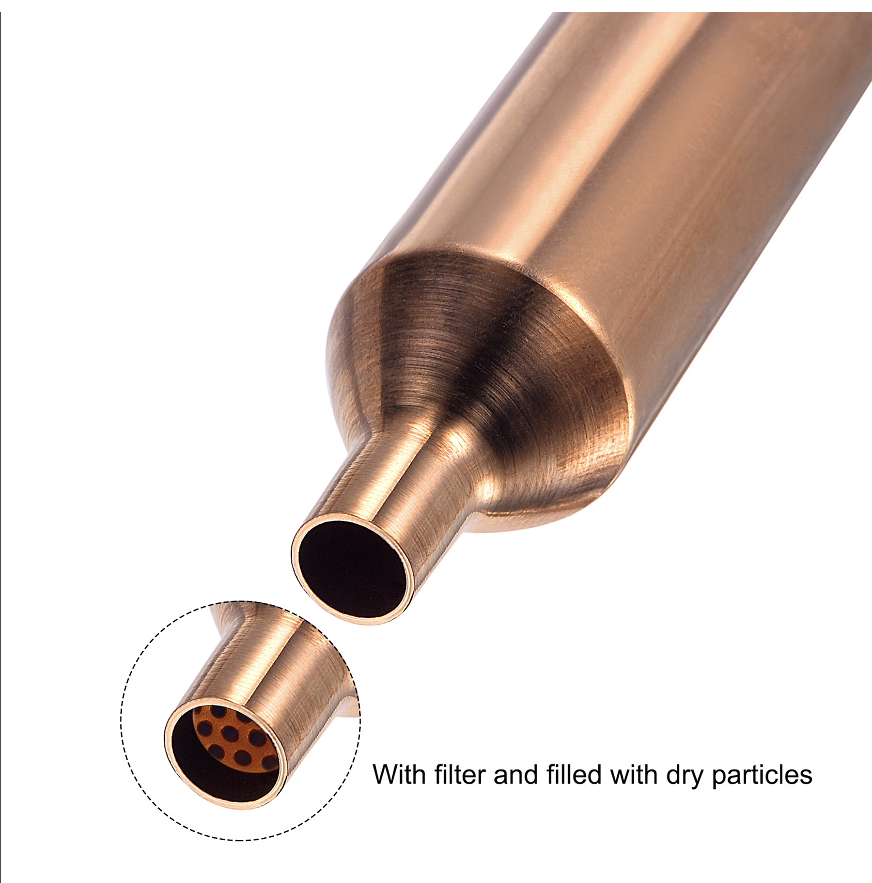
NANTONG, JIANGSU, CHINA, June 24, 2026 /EINPresswire.com/ — The global landscape for refrigeration and HVAC components is currently undergoing a significant technological shift. Manufacturers of household appliances and commercial cooling systems face increasing pressure to enhance system longevity while reducing refrigerant leakage rates. At the heart of this challenge lies the filter drier, a small but critical component that protects the compressor from moisture and solid contaminants. As the industry moves toward higher precision in tube forming and automated assembly, market players are scrutinizing their equipment suppliers more closely. In this context, the rise of BoBo Machine as a Future Leading Filter Drier Machine Manufacturer In China reflects a broader trend toward integrated, high-precision smart manufacturing. This evolution is driven by a global demand for consistency in mass production, where even a micron-level deviation in tube end forming can compromise the integrity of an entire thermal circuit.
The Technological Evolution of Filter Drier Machinery
The manufacturing of filter driers has evolved from labor-intensive manual processes to highly sophisticated automated sequences. Modern production focuses on three core technical areas: tubing precision, tube end reducing, and rotary spinning. The internal cleanliness and dimensional accuracy of the copper or aluminum tubes serve as the baseline for reliability. Consequently, tubing machines must deliver burr-free cuts and perfectly circular cross-sections to ensure downstream compatibility.
Beyond simple cutting, the processes of tube end reducing and spinning have become critical to the performance of the refrigerant system. These methods form the “neck” of the filter drier, which must withstand high-pressure fluctuations throughout the appliance’s lifespan. Professional manufacturers now utilize CNC-controlled spinning technology to achieve a smooth, localized deformation without thinning the tube walls excessively. This precision ensures that the connection points provide a perfect fit for brazing, which significantly reduces the risk of leaks in the field. As global energy standards become more stringent, the role of high-performance forming machinery in maintaining a vacuum-tight system has never been more vital.
Analytical Evolution: BoBo Machine’s Integrated Approach
The trajectory of BoBo Machine provides a compelling case study on how a specialist in tubing machinery transforms into a comprehensive system provider. Established in 1995, the company spent its early decades perfecting the mechanics of copper and aluminum tube processing. Since integrating industry and trade in 2004, the firm has leveraged its 30 years of experience to bridge the gap between individual mechanical units and integrated production lines. This transition allowed the company to move beyond being a mere supplier to becoming a technical partner for global brands like Midea, Siemens, and LG.
A key factor in this rise is the development of modular equipment designs. By focusing on specialized copper tube end forming and reducing machines, the company addresses the diverse needs of different appliance platforms. Whether a client produces residential refrigerators or commercial HVAC units, the machinery can be adjusted for various tube diameters and wall thicknesses. This modularity, supported by an elite team where 66% are seasoned engineers, allows for rapid customization. For global manufacturers, this means the equipment can adapt to shifting product designs without requiring a complete overhaul of the factory floor.
Evaluating International Performance and Engineering Support
The true test of a manufacturing partner lies in its ability to meet international standards and adapt to local production conditions. Analysis of recent projects reveals a significant footprint in global markets, spanning 102 countries and regions. For instance, the delivery of specialized tube end reducing and spinning machines to markets like Turkey and Mexico demonstrates a capacity for global compliance. These projects often involve complex logistics and on-site installations that require a high degree of engineering coordination.
On-site engineering support remains a decisive factor for international buyers. Delivering over 150 projects annually requires more than just mechanical proficiency; it requires a deep understanding of localized manufacturing environments. Case studies from installations, such as refrigerator evaporator lines in Hefei, illustrate the company’s ability to synchronize equipment with existing factory workflows. This system-level thinking ensures that the “Smart Manufacturing” objective is not just a slogan but a practical reality. By providing comprehensive after-sales engineering, a manufacturer ensures that the equipment maintains its OEE (Overall Equipment Effectiveness) in diverse geographical and cultural contexts.
R&D Investment as a Catalyst for Growth
Sustainability in the machinery sector is directly linked to research and development. As a national high-tech enterprise, the commitment to innovation is evident in the financial allocation of 11% of annual revenue toward R&D. This investment fuels the continuous upgrade of products and has resulted in 45 invention patents. These patents often cover critical improvements in hydraulic control, high-speed feeding, and precision spinning, which are essential for maintaining a competitive edge in the filter drier sector.
Furthermore, cross-industry experience provides a unique advantage. By working with top-tier brands like Samsung, B/S/H, and Bundy, a manufacturer gains exposure to the most rigorous quality audits in the world. This experience filters back into the machine design, resulting in equipment that is more resilient, easier to maintain, and capable of higher throughput. The ability to tackle complex demands efficiently is a byproduct of decades of accumulation in heat exchange technology, from fins and tubes to the critical protection components like filter driers.
Conclusion: Positioning for Global Leadership
The rise of BoBo Machine in the filter drier sector is the result of a long-term strategy that combines technical depth with global service support. Its evolution from a tubing machinery specialist to a future leading filter drier machine manufacturer in China highlights the importance of system-level thinking in modern manufacturing. By integrating R&D, customized engineering, and a robust international service network, the company provides a blueprint for “Smart Manufacturing in China” on the world stage.
For international buyers, the decision-making process now involves looking beyond the price tag to the total cost of ownership and the supplier’s engineering pedigree. The combination of over 30 years of experience, a high concentration of engineering talent, and a proven track record across 102 countries positions the firm as a strategic partner for the future. As the HVAC&R industry continues to advance toward more complex and efficient designs, the demand for high-precision filter drier production solutions will only intensify.
For more information on integrated filter drier and heat exchange production solutions, please visit: https://heat-exchange.com/.
BOBO Machine Co.,Ltd.
BOBO Machine Co.,Ltd.
+ +8615962807500
email us here
Visit us on social media:
LinkedIn
YouTube
Other
Legal Disclaimer:
EIN Presswire provides this news content “as is” without warranty of any kind. We do not accept any responsibility or liability
for the accuracy, content, images, videos, licenses, completeness, legality, or reliability of the information contained in this
article. If you have any complaints or copyright issues related to this article, kindly contact the author above.

Media gallery