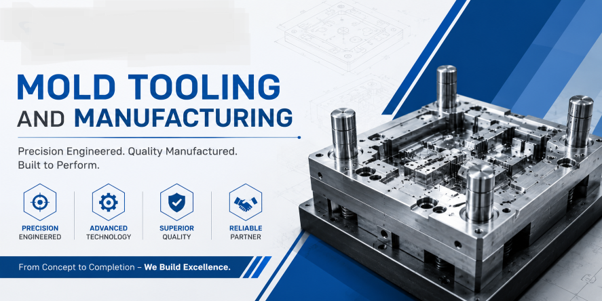
Dalton Manufacturing and Consulting Group delivers integrated mold tooling, fabrication, and parts manufacturing solutions for streamlined production.
CLEVELAND HEIGHTS, OH, UNITED STATES, July 29, 2026 /EINPresswire.com/ — Industrial manufacturing continues to move toward production systems that connect design, tooling, fabrication, inspection, and delivery in one coordinated flow. In that environment, mold tooling and manufacturing have become an important part of larger production programs because it supports repeatable output, tighter process control, and clearer alignment between product design and final delivery. Dalton Manufacturing and Consulting Group describes a contract-based manufacturing model that includes parts manufacturing, plastic molding, metal fabrication, carbon fiber molding, and parts design, all organized around a connected workflow intended to move projects from concept to finished product with controlled execution and specification-focused output.
Across industrial markets, production buyers continue to look for systems that can support higher-volume work without creating friction between stages. That trend has increased attention on a custom parts manufacturer model that can manage tooling, prototyping, fabrication, and assembly in one structure rather than across disconnected vendors. Dalton Manufacturing and Consulting Group’s service mix includes prototype molds, production molds, molds for castings, machining operations, assembly operations, packaging, overseas shipping coordination, and part design consulting for production optimization. Those functions reflect a production model built to support both early-stage development and larger manufacturing runs.
Contract manufacturing demand continues to rise
Demand for contract manufacturing services has grown as industrial buyers try to scale production without taking on every part of the manufacturing process internally. A contract metal fabrication workflow can be especially useful in that setting because it connects material handling, fabrication, and production planning into one process. Dalton Manufacturing and Consulting Group describes a contract manufacturing structure that supports metal fabrication alongside plastic molding and carbon fiber molding, making it possible for projects that use more than one material type to move through a single manufacturing framework.
The same model is relevant to programs that need both prototype and production support. Publicly described operations include design consulting, prototyping, production tooling, assembly, and packaging. That mix matters because industrial projects often begin with a concept and then move into a build phase only after the design has been reviewed and the production path has been defined. A contract manufacturing company in Ohio can support that transition by combining engineering planning with output coordination rather than leaving the customer to manage separate steps on their own.
Large-scale fabrication depends on controlled tooling and process discipline
A contract metal fabrication program depends on more than raw material and equipment. It also depends on tooling discipline, repeatability, and the ability to keep process changes under control as production increases. Dalton Manufacturing and Consulting Group describes metal fabrication services that cover machining, forming, casting, welding, and forging through a broader contract manufacturing structure. That range is important in industrial production because it allows a project to stay within one coordinated system while moving from design input to finished output.
Large tonnage contract molder manufacturer systems are also part of that broader discipline. High-volume production needs consistent tooling, strong mold performance, and repeatable output across batches. When the mold and the process are aligned, fewer interruptions occur during production, and the part remains closer to the approved design.
That is one reason industrial buyers continue to prioritize manufacturers that can support both high-pressure output and long-run production stability.
Tooling and prototyping remain central to readiness
The production process described by Dalton Manufacturing and Consulting Group gives heavy attention to tooling and prototyping. A mold tooling and manufacturing workflow begins well before high-volume production. It starts with understanding the product requirement, then moves into mold design, then into prototype development, and finally into production tooling once the part has been validated. That kind of progression is important because industrial buyers often need a practical way to test a design before committing to a full production cycle.
The company’s materials explain that prototype molds allow tangible product samples before full-scale production begins, while production molds support the actual run once the design has been approved. Some molds are intended for a few batches, while higher-production tooling may be designed for millions of parts. That difference shows why tooling needs to match the intended output from the start. A mold tooling and manufacturing system that supports both prototype and production stages gives buyers more continuity and reduces the need to restart the process when volume changes.
Engineering design improves manufacturability and consistency
Engineering support is a major part of the workflow because product design must be translated into a form that can actually be produced. A custom parts manufacturer model works best when design reviews, 3D data checks, and material selection happen before tooling begins. Dalton Manufacturing and Consulting Group describes a process that starts with design review and continues through tooling planning, prototype development, and production approval. This sequence helps reduce errors that can occur when a design is not fully aligned with the manufacturing method.
The same approach helps industrial buyers manage cost and timing more effectively. A part that is built for manufacturing is easier to tool, easier to inspect, and easier to reproduce across batches. It also helps keep the project moving with fewer redesign cycles. In that sense, engineering is not an isolated step. It is part of the production system that supports manufacturability, repeatability, and controlled delivery from start to finish.
Plastic molding supports repeatable high-volume output
Plastic injection molding remains one of the key production methods in the broader service mix. Dalton Manufacturing and Consulting Group describes plastic molding as a highly efficient way to produce large quantities of parts with consistent shape and repeatable quality. The process uses melted plastic material, molds it, cools it, and ejects the finished part in a cycle designed for scale and consistency.
A custom parts manufacturer that can support molding at this level is useful in industrial programs where the same component must be produced many times without losing dimensional control. The public materials also note that minimum order quantities can apply, which fits a production model built for industrial volume rather than one-off supply. That detail helps explain why buyers often work with a custom parts manufacturer when they need stable output for a large program instead of a single replacement piece.
Quality control remains embedded throughout the workflow
Quality control is presented as a continuous process rather than a final check. Dalton Manufacturing and Consulting Group describes ISO 9001-certified quality management, along with inspection, material certification, third-party checks, polymer analysis, and testing. Those controls are designed to verify that parts meet required dimensions, material standards, and performance expectations before delivery.
In a mold tooling and manufacturing environment, that matters because errors can multiply quickly across a large production run. If a mold is not aligned with the approved part or if tooling is not maintained properly, the result can affect many units at once. For that reason, inspection and tooling discipline are tied closely together. The process is strongest when quality checks happen early, during production, and at final review, not only after the parts are completed.
Supply coordination supports larger and more complex programs
Industrial supply chains work best when material access, tooling, production, and shipping are coordinated in one system. Dalton Manufacturing and Consulting Group describes a network of manufacturing facilities, raw material suppliers, and engineering teams that support both domestic and international manufacturing. That structure allows work to move through different stages without losing track of the schedule or specification.
A contract metal fabrication program depends on that kind of coordination when multiple materials or production methods are involved. Some projects require metal work, while others require plastic molding or composite processing. When those steps are managed through one flow, the buyer has fewer handoffs to manage and more visibility into production timing. That makes supply coordination one of the main reasons industrial buyers continue to rely on a contract metal fabrication model for larger programs.
Industrial applications span several sectors
The overall manufacturing model is used across industrial, medical, and consumer product categories. Dalton Manufacturing and Consulting Group also describes work in seating components, conveyor belt sprockets, plastic molding, metal fabrication, carbon fiber molding, and design support. That mix shows how a custom parts manufacturer can support projects that involve different materials, different shapes, and different levels of production complexity.
A contract metal fabrication system is especially relevant in those settings because many programs require parts that must perform under load, fit into larger assemblies, or be repeated across high volumes. When the process is designed around controlled production, the result is a more stable output and better alignment between the final component and the original project requirements.
About Dalton Manufacturing and Consulting Group
Dalton Manufacturing and Consulting Group has served customers since 1998 and describes its work as parts manufacturing on a contract basis. The operation includes prototype molds, production molds, molds for castings, machining operations, assembly operations, packaging, overseas shipping coordination, and part design consulting for production optimization. The business is located at 2424 Lamberton Road in Cleveland Heights, Ohio, and works through a network of manufacturing facilities, raw material suppliers, and engineering teams. The service structure includes plastic molding, metal fabrication, carbon fiber molding, and parts design as part of a broader manufacturing model built to support controlled production and repeatable output. This structure aligns closely with a contract metal fabrication approach that supports consistent workflows from design to finished component delivery.
Mac Dalton
Dalton Manufacturing and Consulting Group
+1 216-570-5250
macdsolutions@gmail.com
Visit us on social media:
LinkedIn
Facebook
Other
Legal Disclaimer:
EIN Presswire provides this news content “as is” without warranty of any kind. We do not accept any responsibility or liability
for the accuracy, content, images, videos, licenses, completeness, legality, or reliability of the information contained in this
article. If you have any complaints or copyright issues related to this article, kindly contact the author above.

Media gallery