
Multiple High-Grade Drill Intercepts, Broad Intervals and Holes Ending in Mineralization Signal a Growing Gold System; Six Additional Drill Holes Pending
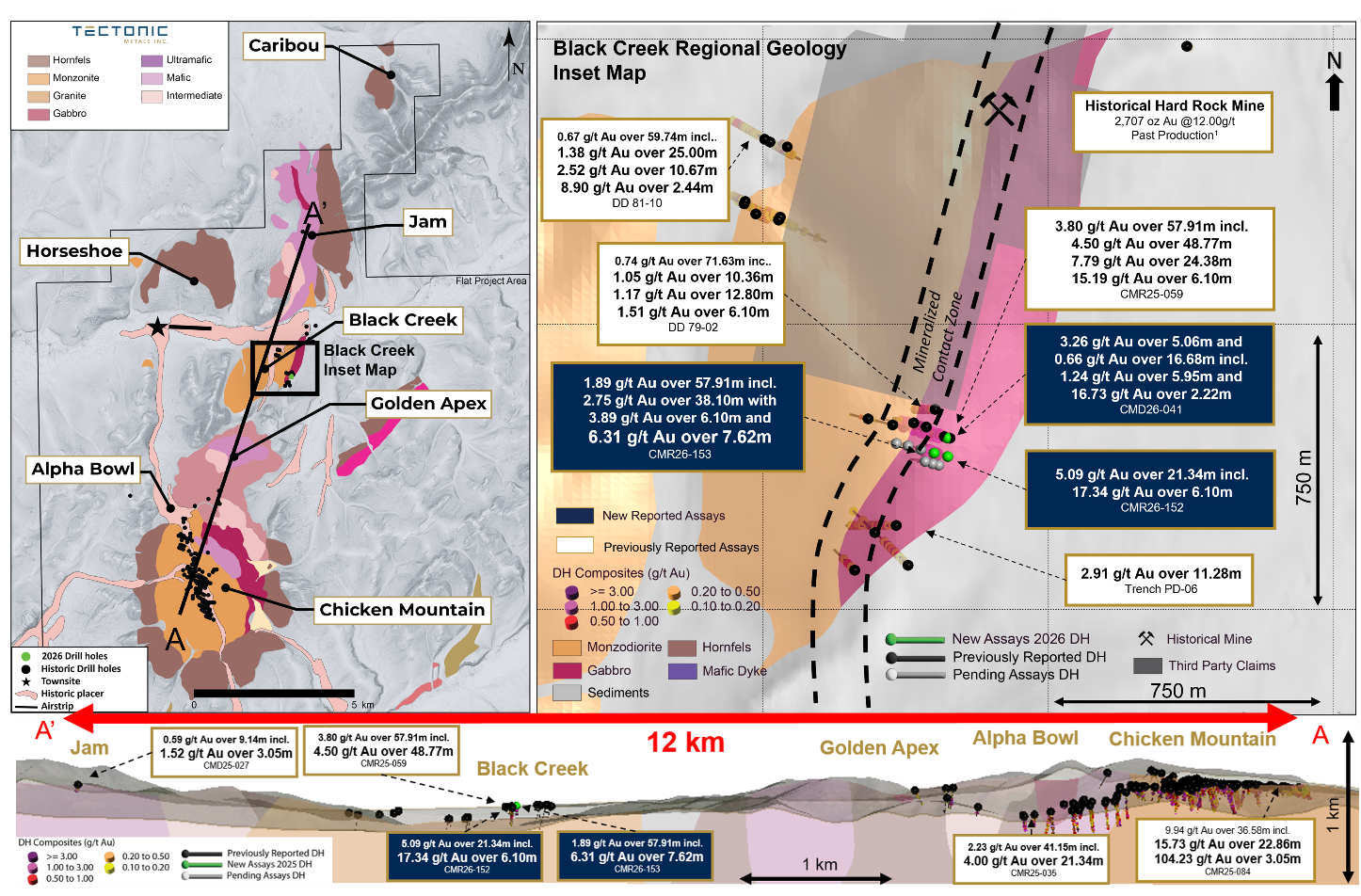
VANCOUVER, BC / ACCESS Newswire / August 25, 2026 / Tectonic Metals Inc. (“Tectonic” or the “Company“) (TECT:TSXV)(TETOF:OTCQB)(T15B:FSE) today reported new drill assay results from Black Creek, one of six intrusion-related district targets located within the Company’s flagship 99,840-acre Flat Gold Project (“Flat“) in southwest Alaska, U.S. The results confirm a second consecutive season of high-grade gold mineralization at Black Creek and strengthen the Company’s view that the target has the potential to emerge as a second gold intrusive centre at Flat, approximately six kilometres (“km”) northeast of the main bulk-tonnage, heap leach Chicken Mountain target.
2026 Black Creek Drill Assay Highlights
-
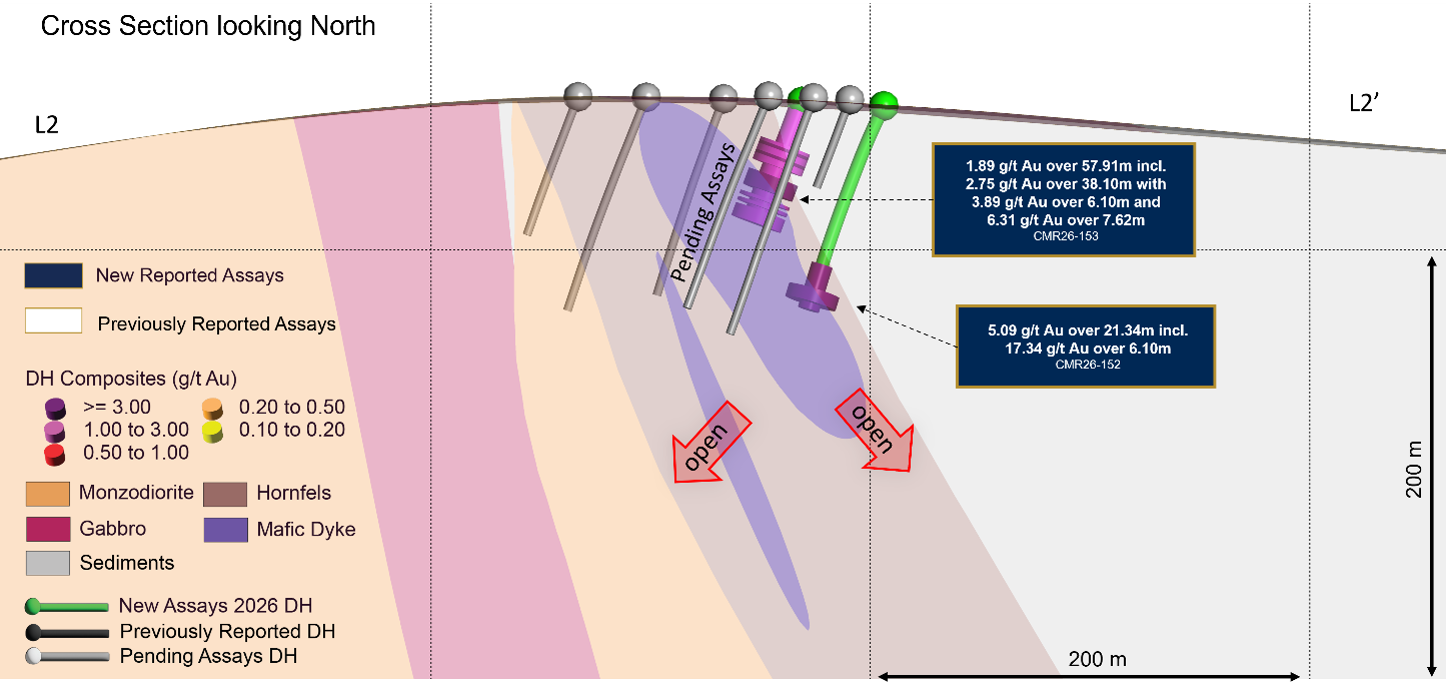
CMR26-152: 5.09 grams per tonne gold (“g/t Au”) over 21.34 metres (“m”) including 17.34 g/t Au over 6.10 m;
-
CMR26-153: 1.89 g/t Au over 57.91 m, including 2.75 g/t Au over 38.10 m with 6.31 g/t Au over 7.62 m and 3.89 g/t Au over 6.10 m; and,
-
CMD26-041: 3.26 g/t Au over 5.06m and 16.73 g/t Au over 2.20 m, including 29.91 g/t Au over 1.22 m.
-
Importantly, both reverse-circulation (“RC”) holes CMR26-152 and CMR26-153 ended in mineralization, providing clear opportunities to expand the system further at depth and along strike.
Multimedia
Assays are also pending from six additional Black Creek drill holes, including holes that intersected prospective hornfels and mafic dykes, features typically associated with higher-grade mineralization at Black Creek and other Reduced Intrusion Related Gold Systems (RIRGS).
The latest results build on Black Creek’s initial 2025 drilling, reported by the Company on January 29, 2026[1], which returned 4.50 g/t Au over 48.77 m, including 7.79 g/t Au over 24.38 m and 15.19 g/t Au over 6.10 m. Together, the recurring high-grade results, broad mineralized intervals, large exploration footprint and improving geological model strengthen Tectonic’s view that Black Creek has the potential to emerge as a second gold intrusive centre at Flat.
Tony Reda, Co-Founder, President & CEO of Tectonic Metals, commented:
“Our 2025 drilling established Black Creek as a compelling high-grade discovery. These 2026 results take it further, delivering multiple high-grade intercepts over meaningful widths with the system remaining open in all directions. Importantly, high-grade gold is now recurring across multiple holes and successive drill programs within the same prospective hornfelsed intrusion-margin setting. Together, these results are defining a coherent geological pattern and providing growing evidence of a potentially significant gold system.
“I have always believed that big gold systems leave big footprints. At Black Creek, drilling lies within a much larger, kilometre-scale convergence of gold-in-soil anomalies, geophysics, favourable geology and significant historical placer and lode gold production. We have tested only a small portion of that footprint, yet we are already seeing important indicators of grade and scale. Our next step is to further understand the geological controls, establish continuity and systematically test the scale of the system.
“Located six kilometres from Chicken Mountain, Black Creek is emerging as a potential second significant gold centre within Flat’s more than 20-kilometre-long volcano-plutonic complex. Its high-grade mineralization occurs in a different host rock than the monzonite-dominant mineralization at Chicken Mountain, demonstrating that gold at Flat is not confined to a single intrusion or geological setting. Black Creek is one of six kilometre-scale intrusion-related targets identified to date, collectively highlighting an opportunity that extends well beyond one potential deposit, one intrusion and one host rock.”
Figure 1: Simplified regional geology map of the Flat Gold Project, highlighting the Black Creek drilling area.
Black Creek: Building Evidence of a Second Gold Centre
Tectonic prioritized Black Creek for follow-up drilling in 2026 after its first-ever program at the target returned near-surface high-grade gold in hornfelsed sedimentary rock: 4.50 g/t Au over 48.77 m in hole CMR25-059, including 7.79 g/t Au over 24.38 m and 15.19 g/t Au over 6.10 m. The 2026 program was designed to test whether the 2025 drill discovery was part of a broader mineralized system.
The new drilling was successful in expanding the Black Creek system. High-grade gold has now been intersected in multiple holes and successive drill campaigns, with broad mineralized envelopes surrounding higher-grade internal intervals. Both 2026 RC holes ended in mineralization, and the deepest high-grade interval in diamond hole CMD26-041 occurs at approximately 202 m downhole, demonstrating gold mineralization through a substantial vertical range.
Broader mineralization of 0.39 g/t Au over 29.50 m, 0.66 g/t Au over 16.68 m and 0.41 g/t Au over 27.25 m was hosted in heavily fractured oxidized and non-oxidized hornfels and altered mafic dyke units with centimetre- to millimetre-scale quartz-to-quartz carbonate veining. Higher grade intervals, represented by 16.73 g/t Au over 2.22 m. were hosted within quartz-carbonate-stibnite veining. This newly intersected mineralization in the diamond drilling suggests that mineralization continues at depth from near-surface high-grade mineralization and remains open in all directions.
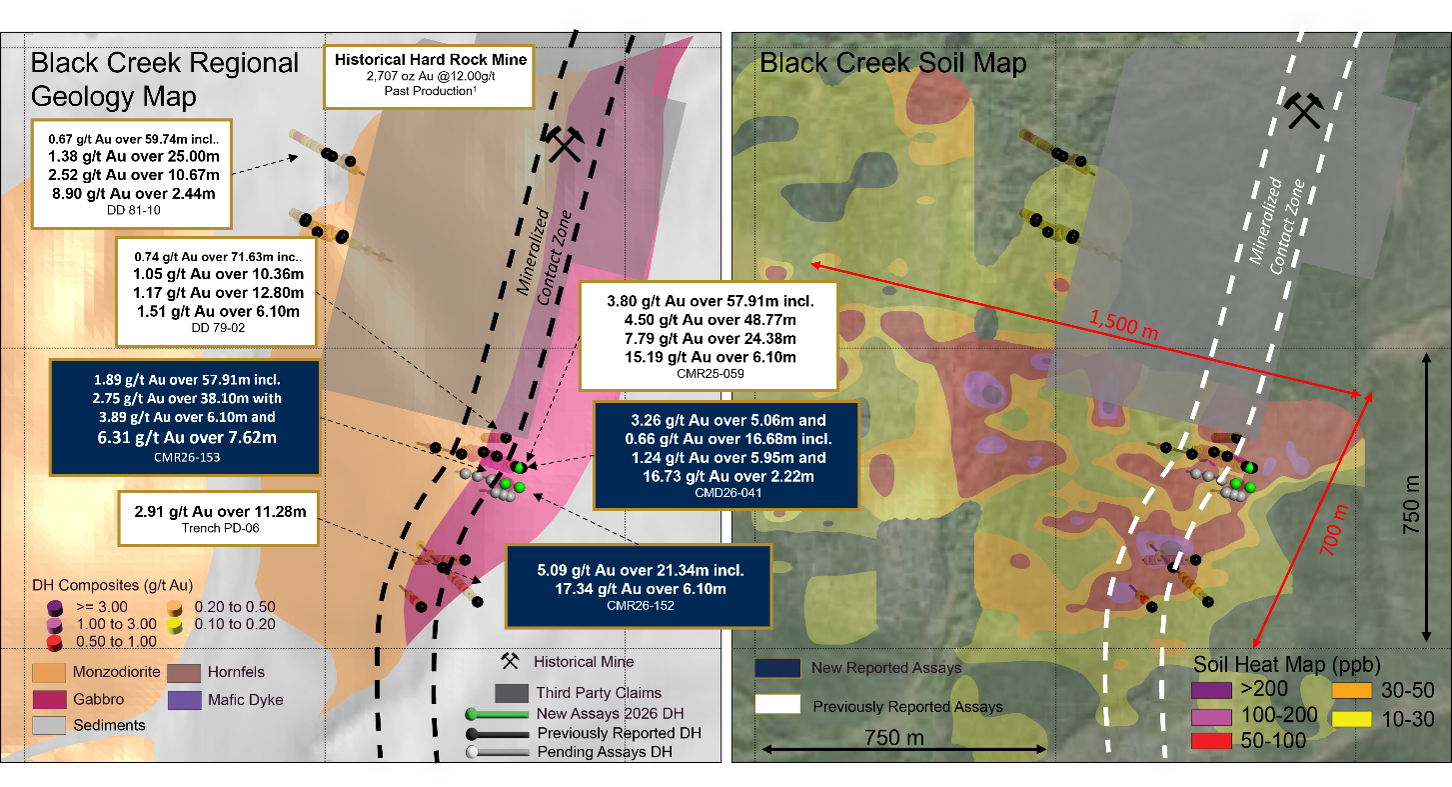
The Black Creek intrusion lies approximately six km northeast of Chicken Mountain within the more than 20-kilometre-long Flat volcano-plutonic complex. The target is supported by a 2.3 km by 1.5 km resistive electromagnetic anomaly and an approximately 1,500 m by 700 m gold-in-soil anomaly, providing a large exploration framework relative to the area tested by drilling to date.
The broader target area also has a substantial historical gold endowment and a long history of placer gold production, totalling approximately 450,000 ounces from Black Creek and upper Otter Creek. The historical hard rock mine at Black Creek reportedly produced approximately 2,707 ounces of gold at an average grade of 12.00 g/t Au between 1925 and 1938.[2]
The convergence of historical gold production, kilometre-scale soil and electromagnetic anomalies, and repeat high-grade bedrock intercepts signals a compelling, multi-dataset exploration vector. Drilling has tested only a small portion of that broader footprint.
Figure 2: Black Creek regional geology, drilling area, and soil contour map, highlighting the mineralized corridors and the gold-in-soil anomaly
Drilling Refines the Geological Model at Black Creek and Other Regional Targets, Providing Clearer Vectors to Higher-Grade Gold
The 2026 program is materially improving Tectonic’s understanding of the lithological and structural controls on gold at Black Creek and providing a vectoring framework that may be applicable elsewhere across the Flat district.
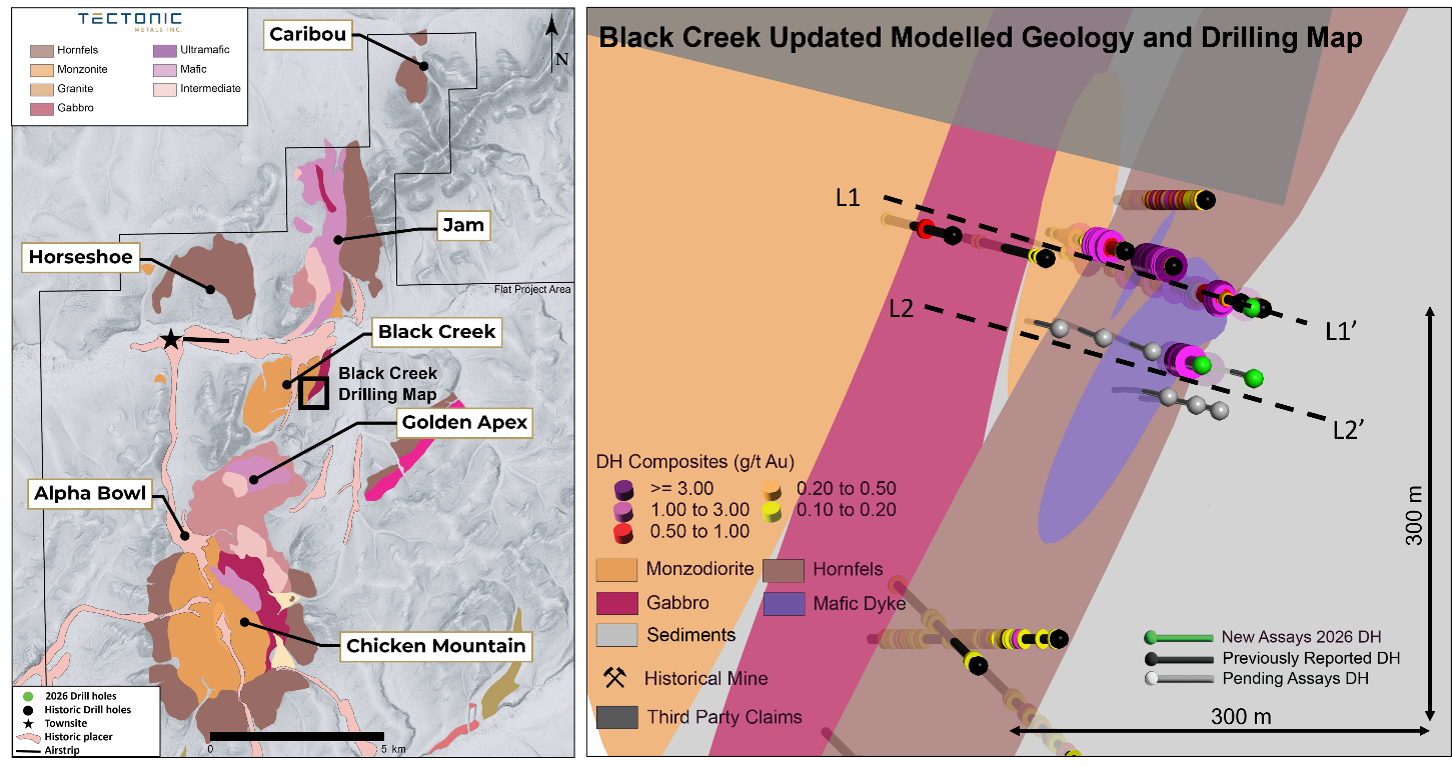
Gold is hosted principally in altered and hornfelsed Kuskokwim Group clastic sedimentary rocks and is associated with quartz to quartz-carbonate-stibnite veining, oxidation, fracturing and mafic dykes. Higher-grade intervals occur within this broader mineralized hornfels package, locally near mapped or modelled mafic dykes.
This host setting is geologically important because hornfelsed sedimentary rocks occur along intrusion margins elsewhere at Flat, including Chicken Mountain, Golden Apex, Horseshoe, Jam and Caribou. As a result, Black Creek establishes a district-relevant exploration model in a host rock that significantly expands the prospective search space beyond intrusion-hosted mineralization alone.
Updated geologic modelling is integrating lithology, hornfels intensity, mafic dykes, intrusion contacts, veining and assay data. The emerging model will be used to test whether higher-grade shoots are controlled by intrusive contacts, dyke margins, structural permeability, or the intersection of these features. Oriented follow-up drilling is required to resolve geometry and true widths.
Figure 3: Updated geological model of the Black Creek Target Area, notably updated hornfels and mafic dyke units that have been observed and characterized to host higher-grade gold mineralization.
Maggie Layman, Vice President Exploration, commented:
“The 2026 drilling is providing an important step forward in our understanding of Black Creek. The association of mineralization with hornfels, mafic dykes and intrusion contacts is helping us refine our geological model and identify priority targets for follow-up drilling.
“With mineralization remaining open in multiple directions and additional assays pending, we see a strong opportunity to continue expanding and defining not only the Black Creek system but also to apply these geological insights to other priority targets across the Flat district.”
Multiple Catalysts Ahead
Tectonic is advancing Black Creek alongside Chicken Mountain and a portfolio of kilometre-scale intrusion-related targets as part of a systematic strategy to test the full district-scale potential of Flat. Near-term catalysts and exploration activities include:
-
Assays pending from six additional Black Creek drill holes, several of which intersected prospective hornfels and mafic dykes;
-
Follow-up drilling below CMR26-152 and CMR26-153 and along strike to test continuity, orientation and true width;
-
Integration of assay, structural, lithological and geophysical data into the three-dimensional geological model; and
-
Application of the emerging Black Creek targeting model to other intrusion-margin targets across the Flat district.
-
Additional assay results from Chicken Mountain are also expected as Tectonic continues expansion and resource-definition drilling toward a maiden mineral resource estimate targeted for early 2027.
Figure 4: Cross section L1-L1′ showing updated Mafic Dyke units and Hornfels, highlighting the higher-grade mineralization across the drilled section
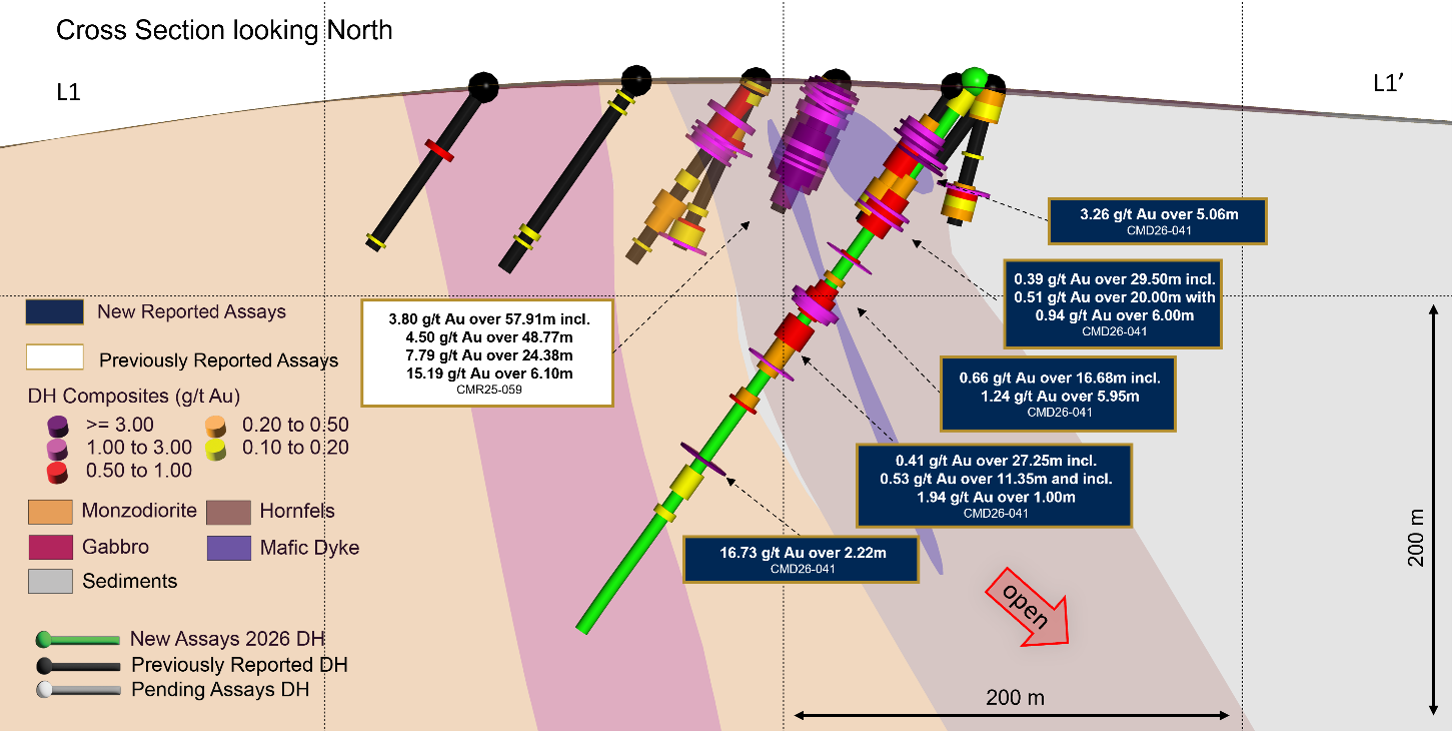
Figure 5: Cross section L2-L2′ showing updated geological model, highlighting the latest high-grade drill composites and holes with assays pending.
A summary of the assay results is presented in Table 1.
Table 1 – 2026 Black Creek Drill Assay Results
|
Hole ID |
From (m) |
To (m) |
Length (m) |
Au (g/t) |
|
|
CMD26-041 |
4.57 |
15.00 |
10.43 |
0.19 |
|
|
Diamond Drill |
|||||
|
Total Depth = 294.43 m |
36.94 |
42.00 |
5.06 |
3.26 |
|
|
End in Min: No |
|||||
|
49.50 |
79.00 |
29.50 |
0.39 |
||
|
including |
59.00 |
79.00 |
20.00 |
0.51 |
|
|
with |
65.50 |
71.50 |
6.00 |
0.94 |
|
|
92.50 |
94.30 |
1.80 |
0.76 |
||
|
103.76 |
106.59 |
2.83 |
0.32 |
||
|
108.63 |
125.31 |
16.68 |
0.66 |
||
|
including |
113.50 |
124.05 |
10.55 |
0.95 |
|
|
with |
117.50 |
123.45 |
5.95 |
1.24 |
|
|
128.50 |
155.75 |
27.25 |
0.41 |
||
|
including |
128.50 |
140.00 |
11.50 |
0.53 |
|
|
and including |
151.00 |
152.00 |
1.00 |
1.94 |
|
|
166.70 |
173.50 |
6.80 |
0.37 |
||
|
including |
172.00 |
173.50 |
1.50 |
0.92 |
|
|
201.78 |
204.00 |
2.22 |
16.73 |
||
|
including |
201.78 |
203.00 |
1.22 |
29.91 |
|
|
208.50 |
221.00 |
12.50 |
0.17 |
||
|
229.40 |
233.00 |
3.60 |
0.10 |
||
|
CMR26-152 |
77.72 |
99.06 |
21.34 |
5.09 |
|
|
RC |
including |
89.92 |
96.01 |
6.10 |
17.34 |
|
Total Depth = 99.06 m |
|||||
|
End in Min: Yes |
|||||
|
CMR26-153 |
1.52 |
59.44 |
57.91 |
1.89 |
|
|
RC |
including |
21.34 |
59.44 |
38.10 |
2.75 |
|
Total Depth = 59.44 m |
with |
22.86 |
28.96 |
6.10 |
3.89 |
|
End in Min: Yes |
and with |
36.58 |
44.20 |
7.62 |
6.31 |
Note: All reported intercepts are downhole lengths, as insufficient data exist to determine true widths. Select composites utilize 0.10, 0.30 or 0.50 g/t Au cut-offs, with a maximum continuous interval of 3.20 m (two sample) below the applicable cut-off inclusion.
Table 2. Drill Hole Details at Black Creek
|
Hole ID |
Type |
Azimuth (o) |
Dip (o) |
Length (m) |
UTM E |
UTM N |
Prospect |
Purpose |
|
CMD26-041 |
DDH |
285 |
-55 |
294.43 |
555484 |
6923701 |
Black Creek |
Exploration |
|
CMR26-152 |
RC |
285 |
-70 |
99.06 |
555486 |
6923652 |
Black Creek |
Exploration |
|
CMR26-153 |
RC |
285 |
-70 |
59.44 |
555449 |
6923661 |
Black Creek |
Exploration |
Qualified Person
Tectonic Metals’ disclosure of technical or scientific information in this press release has been reviewed, verified and approved by Peter Kleespies, M.Sc., P.Geo., Chief Geological Officer, who is a Qualified Person in accordance with Canadian regulatory requirements set out in National Instrument 43-101.
Analytical work for the 2026 Flat project drilling program was performed by ALS Global (“ALS”), an internationally recognized and accredited laboratory independent of Tectonic. On-site, core and reverse circulation samples were sealed in security-tagged bags and shipped under strict chain-of-custody protocols to the Lynden Transport logistics operator in Anchorage, Alaska, for delivery to ALS facilities in Vancouver, British Columbia.
Upon arrival at the laboratory, samples were dried, crushed to 2 mm and riffle split into nominal 500-gram subsample aliquots (prep codes CRU-31, SPL-32a). One portion was analyzed for gold using PhotonAssay™ (ALS code Au-PA01). PhotonAssay™ uses high-energy X-rays to determine gold content from a large sample aliquot, typically 500 g of crushed material. The method is non-destructive and is particularly suited to gold systems where larger sample aliquots may improve representativity. If additional nominal 500-gram PhotonAssayTM analysis splits are conducted for a given sample, results from all splits are combined on a weight average basis. A second portion was pulverized such that 85% of the sample passed 75 µm, (PUL-31) and was analyzed by four-acid digestion with ICP-MS finish for 48 elements (ME-MS61), along with aqua regia digestion with ICP-MS finish for trace levels of mercury (Hg-MS42).
Quality assurance and quality control (QA/QC) protocols included the insertion of certified reference material every 20 samples, blank samples at rate of approximately every 25 samples and field duplicate samples (split from the original approximately 1.5 m for RC or 1.5 m for core intervals) every 25 samples. All QA/QC results returned values within acceptable limits.
About Tectonic Metals Inc.
Tectonic Metals Inc. is a mineral exploration company led by an experienced and well-respected technical and financial team with a track record of wealth creation for shareholders. The Company is focused on exploring and developing its flagship Flat Gold Project in southwestern Alaska, covering 99,840 acres of predominantly Native-owned land belonging to Doyon, Ltd., a leading Alaska Native Regional Corporation and one of Tectonic’s largest shareholders. The current focus is on advancing the Chicken Mountain target, one of six multi-kilometre-scale intrusion zones at the Flat Gold Project, where drilling has achieved a 100% success rate across 191 holes to date.
Founded by key members of the Kaminak Gold team behind the discovery and advancement of the Coffee Gold Project, which was acquired by Goldcorp for $520 million in 2016, Tectonic brings a proven track record in exploration, project advancement, capital markets and value creation. Collectively, the team has helped identify more than 30 million ounces of gold, advanced 18 projects through to feasibility, permitted 20 projects, completed over $3 billion in mergers and acquisitions and raised more than $2 billion in capital.
Tectonic ‘s mission is to be a shift in the game: working for our shareholders and the communities where we operate, putting people first, playing big and staying true to our word every step of the way.
On behalf of Tectonic Metals Inc.,
Tony Reda
President and Chief Executive Officer
For further information about Tectonic Metals Inc. or this news release, please visit our website at www.tectonicmetals.com or contact:
Keren Yun
Vice President, Investor Relations
Toll-free: 1.888.685.8558
Email: investorrelations@tectonicmetals.com
Cautionary Note Regarding Forward-Looking Statements, Historical Information and Visual Observations
This news release contains “forward-looking statements” and “forward-looking information” (collectively, “forward-looking statements”) within the meaning of applicable Canadian securities laws. All statements herein that are not statements of historical fact may be deemed to be forward-looking statements. Forward-looking statements are often, but not always, identified by words such as “may,” “will,” “should,” “anticipate,” “believe,” “expect,” “intend,” “plan,” “estimate,” “potential,” “target,” or similar terminology, or that events or conditions “may” or “will” occur.
Forward-looking statements in this release include, but are not limited to, statements regarding: the potential for mineralization at Tectonic’s projects; the nature, scope, and timing of future exploration activities; the interpretation of geological observations; the possible size or scale of mineralized systems; the receipt of regulatory approvals, and the anticipated benefits of current and future exploration programs.
This release also refers to historical information, including results from past exploration activities and placer production figures. Such historical information has not been independently verified by Tectonic, may not be reliable, and should not be relied upon as current, NI 43-101 compliant data.
In addition, this release contains, detailed geological notes, and descriptive observations such as alteration styles, mineralogy and visible gold. These observations are preliminary in nature, may not be representative of the entire interval or system, and should not be relied upon as a guarantee of mineralized assay results or as the basis for any investment decision. Investors and readers are cautioned that visual estimates, core photographs, and geological descriptions are not substitutes for laboratory assay results and do not demonstrate the economic viability of any mineral deposit.
Forward-looking statements are not guarantees of future performance. They are based on a number of assumptions made as of the date such statements are provided, including, among others: assumptions regarding future gold and other metal prices; currency exchange and interest rates; favourable operating and political conditions; timely receipt of permits and regulatory approvals; availability of labour, equipment, and services; stability of financial and capital markets; availability of financing on acceptable terms; accuracy of exploration data and geological models; and the ability to successfully advance planned exploration programs. Many of these assumptions are beyond the control of Tectonic and may prove to be incorrect.
Forward-looking statements are subject to known and unknown risks, uncertainties, and other factors that may cause actual results, performance, or achievements to differ materially from those expressed or implied. These risks include, without limitation: risks inherent to mineral exploration and development; volatility of commodity prices; changes in laws, regulations, and policies; delays or inability to obtain required approvals and permits; availability of financing; general economic, political, and market conditions; labour disputes and shortages; equipment and supply risks; environmental and social risks; competition; inaccuracies in exploration results or geological interpretations; and other risks detailed from time to time in the Company’s continuous disclosure filings.
Although management believes the expectations expressed in such forward-looking statements are reasonable as of the date made, there can be no assurance they will prove to be correct. Readers are cautioned not to place undue reliance on forward-looking statements, historical information, or preliminary visual geological observations. Actual results and future events may differ materially from those anticipated. All forward-looking statements contained in this news release are expressly qualified by this cautionary statement. Tectonic disclaims any intention or obligation to update or revise forward-looking statements, whether as a result of new information, future events, or otherwise, except as required by applicable securities laws.
Neither the TSX Venture Exchange nor its Regulation Services Provider (as that term is defined in the policies of the TSX Venture Exchange) accepts responsibility for the adequacy or accuracy of this release.
[2] Historical production figures: “Mineral Occurrence and Development Potential Report, Locatable and Salable Minerals, Bering Sea-Western Interior Resource Management Plan, BLM-Alaska and historic hard rock mine production: “Bundtzen et al 1992, Geology and Mineral Resources of Iditarod Mining District, Iditarod B4 and Eastern B-5 Quadrangles, Southwestern Alaska, DGGS Professional Report 97”. These historical figures have not been independently verified by Tectonic and are not current mineral resources.
SOURCE: Tectonic Metals Inc.
View the original press release on ACCESS Newswire
Media gallery


