
Shenzhen, Guangdong, China – October 16, 2026
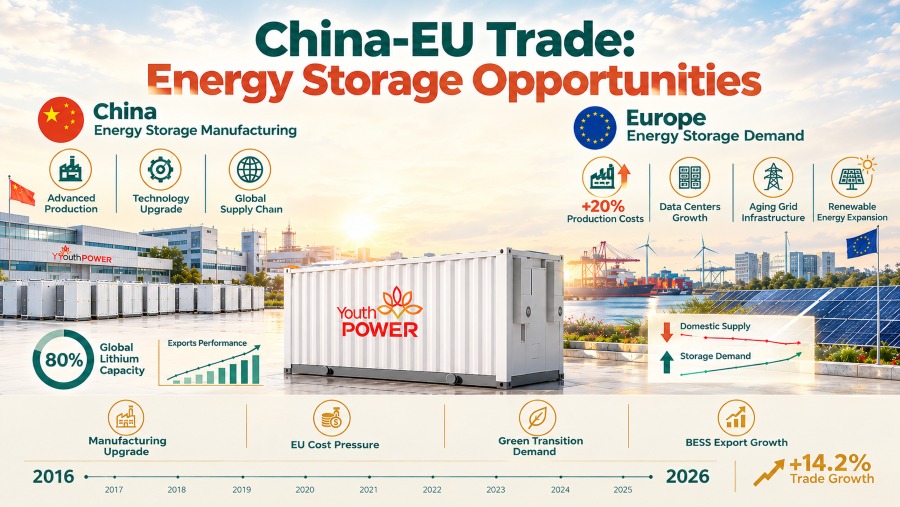
From January to June 2026, the cumulative value of China-EU trade in goods reached $447.88 billion, an increase of 14.2% year-on-year. Notably, exports of transport equipment surged by 50.5%, with lithium-ion batteries emerging as the product category with the largest export growth compared to 2020. These figures reveal a profound trend: China-EU trade is shifting from a traditional model of “complementarity and mutual benefit” toward one characterized by “both competition and friction”—a transition most clearly exemplified by the sector for new energy storage batteries.
A Decade of Evolution in China-EU Trade: From Complementarity to Competition
According to the Report on the Development of China-Europe Economic and Trade Relations (2025)*, published by the Yangtze Industrial Economic Institute at Nanjing University, China-EU trade has unfolded in three phases: a period of stability from 2012 to 2016, rapid growth from 2016 to 2020, and a new, higher level of activity from 2021 to 2024. By 2024, the total value of bilateral trade between China and the EU reached $785.768 billion, with China’s trade surplus with the EU expanding from $92.97 billion in 2017 to $277.087 billion in 2022.
The structure of trade has undergone a fundamental transformation. In 2024, the 16th category—”machinery and mechanical appliances, electrical equipment, and parts thereof”—accounted for $317.988 billion in trade, representing approximately 40% of the total China-EU trade volume. The primary focus of China’s exports to the EU has shifted from traditional consumer goods toward electrical equipment, machinery, and new energy products. Meanwhile, the share of EU exports destined for China fell from 10.5% in 2020 to 7.5% in 2025, indicating a decline in the relative importance of the Chinese market for EU exporters.
Energy Storage Battery Exports: A Growth Engine Amid Policy Adjustments
The energy storage battery industry serves as a quintessential microcosm of the shifts occurring in China-EU trade. In 2023, the export value of Chinese energy storage products reached $33.87 billion, a year-on-year increase of 50.5%. By 2025, the export volume of energy storage batteries is projected to reach 115.3 GWh, up 67.9% year-on-year. Europe is the largest export market for Chinese energy storage products, accounting for approximately 40% of the total, followed by the United States (18.5%), Southeast Asia (12%), and the Middle East (8%).
Notably, China is proactively adjusting its export policies. The export tax rebate rate for batteries will be reduced from 9% to 6% starting in April 2026, and will be eliminated entirely from 2027. This “weaning” process is intended to compel the industry to shift its focus from “price wars” to “quality competition.” It encourages companies to achieve sustainable profitability through technological innovation and comprehensive supply-chain advantages, rather than relying on tax rebates and subsidies. This shift is expected to increase industry concentration, allowing leading firms—those with estab
lished overseas production capacity and strong brand recognition—to capture a larger market share.
Driving Factors — China’s Industrial Upgrade and Europe’s Structural Constraints
This trend is the result of a convergence of three factors: the upgrading of China’s industrial sector, structural constraints within Europe, and unique variables specific to the energy storage industry.
The upgrading of China’s manufacturing sector serves as the fundamental driver. With a foundation built on 80% of the world’s lithium-battery production capacity, leading Chinese firms have developed mature overseas delivery systems. They are capable of providing tailored solutions for diverse environments—ranging from the extreme cold of Northern Europe to the hot, humid climates of Southeast Asia. This success is not merely a product of low pricing, but the result of over a decade of technological accumulation and extensive experience in international project delivery.
Meanwhile, Europe faces structural constraints. Following the crisis in Ukraine, industrial electricity prices in Europe have surged, leaving more than two-thirds of European manufacturing enterprises with production costs that are 20% higher than those in China. Simultaneously, Europe’s “green transition” has created rigid demand: the rapid growth in power consumption from AI data centers, aging power grids, and the expansion of new energy sources have all fueled a robust demand for energy storage systems. As domestic European supply falls short in terms of both cost-competitiveness and production capacity, importing energy storage batteries from China has become a natural market choice.
As analysts have pointed out, “The increased influx of Chinese goods into the European market is not just because ‘China wants to sell,’ but also because ‘Europe needs to buy.’
Strategic Response — EU Compliance Barriers and China’s Countermeasures
Facing competition from Chinese energy storage batteries, Europe’s response has shifted from traditional tariffs toward technical barriers framed as “compliance requirements.” The EU’s New Battery Regulation mandates that batteries carry a “battery passport,” disclosing information such as carbon footprint, recycled content, and supply chain due diligence—a requirement that increases compliance costs by approximately 30%. Meanwhile, the U.S. Inflation Reduction Act (IRA) conditions eligibility for subsidies on a local content threshold of over 50% for battery components.
Chinese enterprises are responding through several strategies: globalizing production capacity (e.g., CATL’s establishment of plants in Germany and Hungary, raising its localization rate to 40%), upgrading carbon management (e.g., BYD’s implementation of a full-lifecycle carbon footprint tracking system), and innovating financial instruments (e.g., Sungrow’s issuance of asset-backed securities for energy storage assets). Compliance capability has emerged as a new competitive barrier; leading firms, having already compiled comprehensive compliance documentation, face a significantly lower probability of being selected for follow-up audits compared to smaller, less-prepared manufacturers.
Future Outlook and Implications for the B2B Sector
According to industry forecasts by CESC, Europe’s newly installed energy storage capacity is projected to reach 26 GW by 2030, representing a compound annual growth rate (CAGR) of 23.1%. Long-duration energy storage technologies, such as sodium-ion and flow batteries, are expected to move toward commercialization. Furthermore, the concentration of solar-plus-storage projects in the Middle East, Australia, and Latin America is helping to offset downward pressure in traditional markets.
For solar product wholesalers, installers, distributors, and EPC contractors, these trends offer a clear takeaway: prioritizing certified suppliers, focusing on compliance capabilities, and developing localized supply chains will be critical to future competitiveness. YouthPOWER supports its global partners with LiFePO4 energy storage solutions that carry UL, IEC, CE, and UN38.3 certifications. Designed for long-term compliance and high performance, these solutions empower B2B buyers to seize new opportunities amidst the evolving landscape of China-Europe trade.
About Us
Founded in 2003, YouthPOWER has now become one of the leading suppliers of solar storage lithium batteries in the world. With a broad range of energy storage solutions, it covers a series of 24V, 48V and higher voltage lithium batteries solutions.
Media Contact
Company Name: Shenzhen Litu New Energy Technology Co., Ltd.
Contact Person: Media Relations
Email: Send Email
Country: China
Website: https://www.youth-power.net/
Press Release Distributed by ABNewswire.com
To view the original version on ABNewswire visit: China-EU Trade Highlights Emerging Opportunities in Energy Storage


