ZIGONG, SICHUAN, CHINA, October 25, 2026 /EINPresswire.com/ — When cultural institutions, science centers, and themed attractions curate exhibits showcasing prehistoric life, the authenticity of the display dictates both visitor engagement and educational credibility. This debate takes center stage in modern curation, prompting a close examination of Wholesale Dinosaur Fossils Supplier options currently available on the global market. Dinosaur Fossils, encompassing everything from complete skeletal mounts to individual replicated bones and teeth, serve as the foundational bedrock for any reputable paleontology exhibition. They bridge the gap between abstract scientific theory and tangible prehistoric reality, allowing millions of visitors to visually and spatially connect with the Mesozoic era. However, museum curators and exhibition designers continuously weigh the merits of specialized manufacturing sources against conventional market alternatives to determine which approach yields superior long-term educational value and aesthetic resonance.
Aesthetic Fidelity vs. Generic Production
The visual impact of a prehistoric exhibition relies heavily on anatomical accuracy and surface-level detailing. Specialized manufacturing processes prioritize rigorous osteological research, ensuring that every vertebral curve, neural spine, and fenestration aligns with paleontological consensus. In contrast, standard mass-produced replicas frequently exhibit generalized proportions and smoothed-over contours to expedite fabrication.
Exhibitions featuring meticulously crafted specimens create an immediate sense of awe upon entry. Visitors of all ages discern the subtle textural variations that mimic fossilized bone, including weathering marks, natural mineralization patterns, and precise joint articulation. This visual depth transforms a static display into an immersive narrative window. When sourcing from established entities such as Hidinosaurs, production teams leverage decades of expertise rooted in Zigong, Sichuan-a region globally recognized as the historic heartland of dinosaur discovery. This geographic advantage grants creators direct access to rich paleontological insights, enabling the replication of complex skeletal structures with museum-grade precision.
Educational Engagement vs. Superficial Spectacle
Beyond visual appeal, museum exhibits must fulfill a rigorous educational mandate. High-value displays encourage scientific inquiry by presenting anatomically correct specimens that accurately reflect biomechanical locomotion, dietary adaptations, and evolutionary lineage. Standard replicas often prioritize striking poses over biological plausibility, occasionally resulting in distorted postures that misinform the public.
Institutions focusing on deep engagement integrate detailed skeletal mounts that allow educators to explain complex anatomical functions, such as bipedal balance, defensive adaptations, and cranial mechanics. A well-crafted fossil display prompts curiosity, encouraging visitors to question how prehistoric creatures interacted with their ancient ecosystems. By deploying scientifically validated models, venues foster an environment where entertainment seamlessly merges with academic enrichment, elevating the overall cultural contribution of the host institution.
Initial Investment vs. Lifecycle Economics
Financial considerations inevitably influence curation, yet the cheapest initial option rarely translates to long-term fiscal efficiency. Standard mass-produced replicas frequently feature lower upfront costs, appealing to tight initial budgets. However, these budget-friendly items typically utilize substandard resin formulations or brittle fiberglass mixes that degrade under environmental stress, varying humidity levels, and high-traffic visitor interactions.
Conversely, professional-grade fabrication utilizes durable, high-density materials reinforced with internal steel frameworks designed to withstand public exhibition demands. While the initial investment for specialized wholesale procurement involves higher upfront capital, the extended operational lifespan significantly reduces replacement and repair frequencies. Over a multi-year exhibition cycle, durable manufacturing minimizes maintenance expenditure, delivering superior cost-efficiency for municipal parks, science museums, and commercial entertainment venues alike.
Durability and Damage Resilience
Public exhibition spaces present unique physical challenges. High visitor volumes, accidental impacts, and fluctuating ambient conditions test the structural integrity of every displayed artifact. Standard replicas often lack internal structural reinforcement, making them vulnerable to cracking, joint separation, and surface abrasion when exposed to everyday museum environments.
Advanced fabrication techniques incorporate robust internal steel armatures combined with weather-resistant, impact-absorbing outer composite layers. This engineering approach protects against accidental structural failure, ensuring that protruding elements such as tails, jaws, and ribs maintain their integrity. Enhanced damage resilience protects the institution’s financial investment while safeguarding visitor safety, eliminating the liability risks associated with fragile display pieces fracturing during peak operating hours.
Technical Innovation and Artisanal Craftsmanship
The evolution of modern exhibition design relies on the integration of advanced technology with traditional hand-sculpting expertise. Industry leaders continuously refine production methodologies to achieve unprecedented levels of realism and structural reliability.
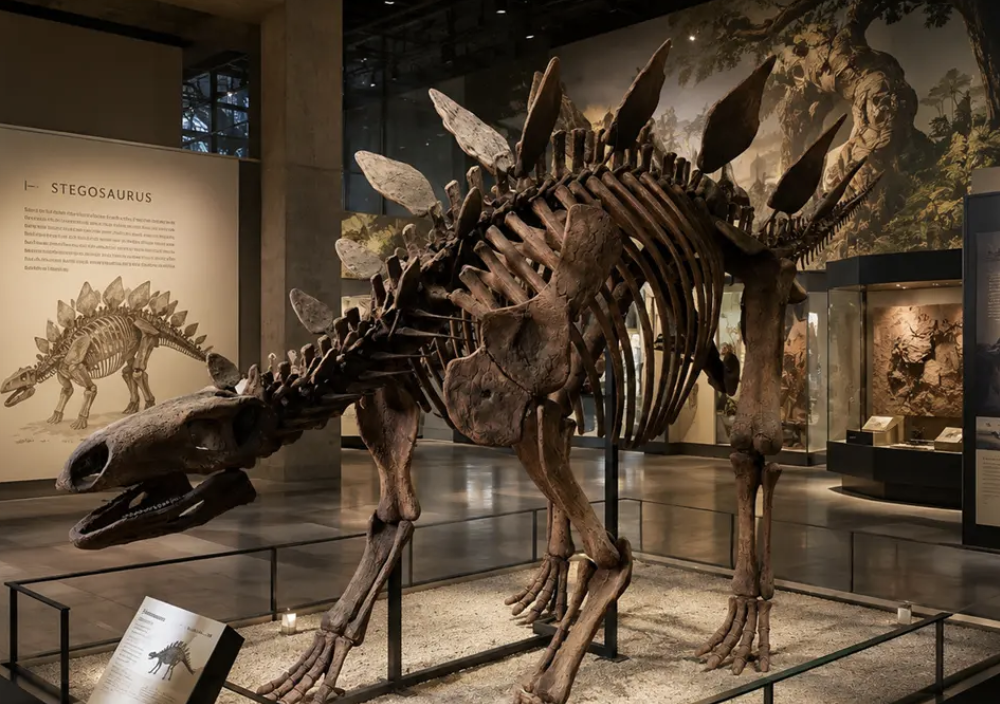
A prime example of this synthesis is visible in complex skeletal configurations, such as the Stegosaurus Skeleton Replica 5M, which showcases the intricate balance between structural engineering and biological authenticity. Measuring five meters in length, this specimen illustrates meticulous attention to dermal plate placement, caudal spike alignment, and vertebral articulation.
Operating from a specialized production base in Zigong, Sichuan, the manufacturing workflow integrates computerized modeling with skilled artisanal carving. Technicians analyze fossil fragments to map out internal support vectors before applying hand-textured skin and bone layers. This dual approach ensures that every exhibit-ranging from massive sauropod skeletons to specialized animatronic displays-meets stringent quality benchmarks. Having exported products to more than 40 countries and regions worldwide, the enterprise successfully equips parks, amusement centers, and science museums with robust, certified installations that comply with international safety and environmental standards.
Curating Long-Term Exhibition Success through Strategic Sourcing
Selecting the appropriate provider for prehistoric displays requires balancing upfront budgeting with long-term exhibition objectives. Institutions aiming to elevate their educational credibility and visual impact benefit from partnering with experienced manufacturers capable of delivering certified, durable, and scientifically accurate installations.
For curators, park directors, and project planners seeking comprehensive exhibition solutions tailored to specific spatial and thematic requirements, establishing a direct supply line ensures strict quality control and customized engineering support. To review complete product portfolios, technical specifications, and past project implementations for your upcoming development, please visit the official enterprise portal at https://www.hidinosaurs.com/.
Hidinosaurs
Hidinosaurs
Legal Disclaimer:
EIN Presswire provides this news content “as is” without warranty of any kind. We do not accept any responsibility or liability
for the accuracy, content, images, videos, licenses, completeness, legality, or reliability of the information contained in this
article. If you have any complaints or copyright issues related to this article, kindly contact the author above.

Media gallery