
Zhuhai, Guangdong, China – November 03, 2026
So, you’re looking for a China-based manufacturer for an Air Chuck and anAir Clip? Honestly, it’s the little things you can actually check that make all the difference. These parts might seem simple, but the fit and finish count a lot. You want a chuck that connects securely to the valve, and an Air Clip that holds firm without any awkward handling. Even small variations in thread dimensions, clip tension, or sealing surfaces can mess with your daily routine. Honestly, before you even think about comparing quotes, you’ve got to ask each supplier for a few things: product drawings, material details, what sample options they have, and the exact specs. It’s the only way to make a fair comparison, trust me.When you’re evaluating a product, don’t just fall for the lowest price – you’ve gotta dig a little deeper. See how the manufacturer handles things like inspection, keeping production consistent, packaging, and how they answer your questions. If you can, get some samples and test them with your existing setup – your hose, gauge, or inflation rig. Give the connections and moving parts a good look, and keep an eye out for any leaks during normal use. And sure, ask for recent quality records, but take them with a grain of salt – they’re just supporting evidence, not a replacement for actually checking the product yourself. Sure, a polished catalog is nice to have, but honestly, it’s not like it’s proof of anything on its own.Honestly, the right pick really comes down to what you’re making, how much you’re ordering, and how much you want to tweak things. Some people just need standard parts and a steady flow of deliveries. Meanwhile, others are all about custom packaging or a specific clip shape. So yeah, you’ve gotta be crystal clear about that stuff. No supplier’s perfect, and that first sample? It can totally reveal things the product page never even mentions. Better to find that out sooner rather than later, right? So, when you’re hunting for an Air Chuck or Air Clip manufacturer, you don’t just want to roll the dice and pick anyone. You’ve got to compare a few things—like how they talk to you, what their specs actually say, how well their samples perform, and what kind of production controls they’ve got in place. Get that mix right, and you’ll end up with a supplier who’s not only practical and upfront but genuinely fits your needs. That’s the sweet spot.
 Air Chucks and Air Clips: Functions, Types, and Core Components
Air chucks connect an air hose to a tire valve, creating a seal so compressed air can flow. A well-fitting chuck helps reduce leaks and makes pressure checks more consistent. An Air Chuck For Air Compressor may use a push-on, clip-on, or threaded connection, depending on the valve and hose setup. Small details matter.
Air clips, often called locking clips, hold the chuck against the valve stem without constant hand pressure. They are useful when inflating several tires or working in a tight space. Common chuck styles include open-flow models, which release air when connected, and shut-off models, which control airflow at the chuck. Check the valve type before choosing; a clip that feels secure may still sit at a slight angle and leak.
The core components are the chuck body, sealing gasket, valve-contact pin, and hose connection. Some models also include a locking lever or internal shut-off valve. Brass and plated metal bodies are common, while rubber sleeves can improve grip and protect nearby surfaces. Inspect the gasket for cracks, then listen for hissing during a brief test. Even a sturdy chuck can lose its seal when the gasket is worn.
Pressure Units Explained: 1 bar = 100 kPa ≈ 14.5 psi
Pressure markings can look simple, but mixing units can lead to an incorrect inflation setting. One bar equals 100 kPa, or approximately 14.5 psi. The psi value is rounded, so small differences may appear when converting precise readings. Check the unit shown on your gauge before adjusting pressure. It is easy to overlook.For a hose connection, an Air Chuck For Air Hose should fit securely and allow air to flow without obvious leakage. Read the gauge while the chuck is seated firmly, and compare its unit with the equipment’s stated pressure range. A reading of 2 bar is about 200 kPa or 29 psi. These conversions help with comparison, but they do not replace the equipment maker’s recommended setting. Gauges can vary in accuracy, especially after heavy use, so verify questionable readings with a suitable, maintained gauge. A snug connection helps. It is not a guarantee of accuracy.
Chuck Designs Compared: Open-Flow, Closed-Flow, Clip-On, and Push-On
China Best Air Chuck and Air Clip Manufacturer for BuyersChuck Designs Compared: Open-Flow, Closed-Flow, Clip-On, and Push-OnOpen-flow and closed-flow designs control what happens when the chuck is not pressing on a valve stem. An open-flow model lets air pass when connected, so it usually needs a trigger or shutoff upstream. A closed-flow chuck has an internal valve and typically releases air only when engaged. That can reduce unintended air loss during setup. Check the chuck’s pressure rating and tire valve compatibility before choosing.Clip-on chucks use a lever or clamp to hold the valve, leaving a hand free to monitor the gauge. Push-on models connect quickly by hand and can help where access is tight, though worn seals may leak. Small detail, big difference. Look for a secure fit, compatible hose threads, and a body that clears nearby spokes. Flow style and attachment style are separate choices, so confirm both in the specifications. A chart may still leave questions about fit. Fit varies.Tips: Test the chuck at low pressure first. Listen for a hiss and watch for a steady gauge reading. Keep the sealing face clean; grit can cause slow leaks. Replace damaged seals rather than forcing a loose connection.
Air Chuck Designs Compared
Open-flow, closed-flow, clip-on, and push-on designs
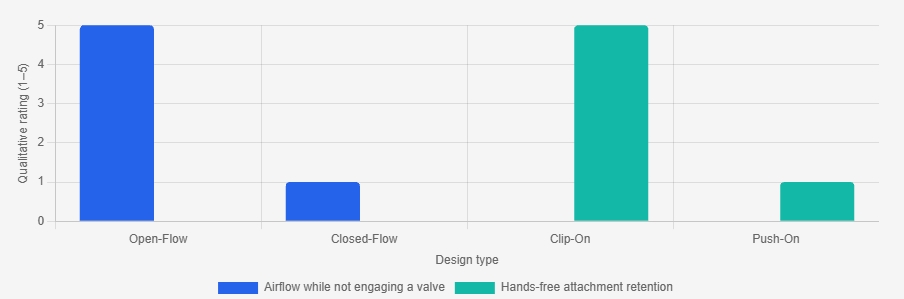
Scores are qualitative indicators on a 1–5 scale, not standardized test results. Open-flow and closed-flow describe how airflow is controlled; clip-on and push-on describe how the chuck attaches to the valve. These are separate design choices, so a clip-on or push-on chuck may also use either flow style.
Materials and Seals: Matching Construction to Pressure and Use
An air chuck or air clip is only as dependable as its body and sealing parts. Brass resists corrosion and suits many workshop fittings, while plated steel can handle frequent handling but may need care around moisture. Aluminum keeps weight down for repeated use. Check the fitting threads and contact surfaces; small mismatches can cause leaks or damage.The seal must match both pressure and working conditions. Rubber compounds vary in resistance to heat, oil, and aging, so confirm the material’s stated limits rather than judging by appearance. For a tire inflator used intermittently, a standard elastomer seal may be appropriate. A line exposed to warm air or oil mist may need a different compound. Not every application is predictable. Inspect seals for flattening, cracks, or a shiny, hardened surface, and replace them when they no longer sit evenly. A quick leak check with soapy water can reveal bubbles around the connection. Keep pressure within the rating marked for the complete assembly, not just its metal body. That detail is easy to miss. Some buyers focus on the chuck’s strength and overlook the seal’s service environment. That is worth reconsidering.
Safety and Air Quality References: ISO 4414 and ISO 8573-1
For buyers comparing an Air Chuck or air clip, safety starts with the whole pneumatic system, not the fitting alone. ISO 4414 provides safety principles for pneumatic systems and their components. Check that the chuck connects securely, releases as intended, and suits the system’s operating pressure. A hose that pulls sideways can loosen a connection. Small details matter.
Air quality has its own reference: ISO 8573-1 classifies compressed air by particles, water, and oil. The right purity class depends on the application and equipment; there is no single class for every workshop. Moisture can collect in a hose, while oil or particles may affect valves and seals. Ask suppliers for the stated air-quality requirements and verify them at the point of use. Clean air helps. It does not fix a poor connection.
These standards are useful evaluation references, not automatic proof that a particular product is certified or suitable. Request clear pressure limits, compatible connection details, and inspection guidance. Then compare them with your own system conditions. A checklist can still miss real handling habits. Operators may twist a chuck under load, or store clips where grit enters the coupling. That deserves a second look. Keep the intended use, maintenance routine, and air supply in view when selecting a manufacturer.
China Supplier Evaluation: Verify Pressure Ratings, Leak Tests, and Traceability
When evaluating a China-based air chuck or air clip supplier, treat the pressure rating as a testable specification, not just a catalog claim. Ask whether it refers to working pressure or burst pressure, and confirm the intended air temperature and duty cycle. A fitting that holds at room temperature may behave differently after repeated connection cycles. Small details matter.Request a sample test report and check the test pressure, duration, and gauge calibration date. Compare those figures with the pressure your equipment will actually use, leaving a sensible operating margin. Leak testing should use a documented method, such as pressure decay or an approved immersion check. Ask how many samples were tested and whether testing happens only during product approval or across regular production. One sample is useful, but it cannot prove every batch is consistent.Traceability makes a failed fitting easier to investigate. Ask for lot codes that link products to inspection records, materials, and production dates. Then check whether the code appears on packaging or the parts themselves. If records are incomplete, ask what can still be verified; a neat report is not automatically a complete one. It is easy to overlook this step when samples look good. Keep the answers with your purchase specification.
Buyer Checklist: Match Thread, Valve Stem, Hose, and Pressure Range
A reliable Air-Operated Chuck starts with the connection, not the catalogue photo. Match thread type, size, and gender to the hose or adapter; NPT and BSP threads may look similar but are not interchangeable. Check the valve stem, too. A chuck designed for a Schrader valve may not seal on another stem style. A quick fit test helps. It is easy to skip.
Confirm the hose’s inner diameter, coupling, and working-pressure rating, then compare them with the chuck’s stated operating range. Use the working pressure, not the burst pressure, when checking compatibility. The U.S. Department of Energy’s 2016 Improving Compressed Air System Performance sourcebook notes that leaks in poorly maintained systems can waste 20–30% of compressor output. That figure describes system losses, not chuck performance, but it shows why a faint hiss at the connection deserves attention. Check the regulator gauge while air flows; static pressure alone can hide a restriction. Specifications still leave an awkward gap: actual fit can vary with worn threads and valve condition. Test the assembled setup before routine use, and recheck the seal after changing hoses.
Conquer Rough Terrain with a Smart Auto-Retractable Off-Road Air Hose System
Smart Auto-Retractable Off-Road Air Hose System
Conquer rough terrain with an air hose system built for dependable performance wherever the trail leads. Its heavy-duty metal construction is made to handle the bumps, dust, and demanding conditions of off-road environments, while the 7-meter retractable hose gives you useful reach around your vehicle. When the job is done, the hose can be wound back in neatly, helping keep your setup organized and ready for the next stop.A precision manual crank provides controlled hose operation, and a pressure-adaptive anti-jam lock is designed to help prevent snags as you extend or retract the line. Whether you’re checking tire pressure at a chilly campsite or preparing for a warm-weather trail, the system is designed to operate across a wide temperature range from -20°C to +70°C. Combining rugged materials, practical reach, and smooth manual control, it offers a convenient way to keep an air hose accessible during all-terrain travel.
Conclusion
Choosing the right Air Chuck + Air Clip begins with understanding how each design connects to a tire valve and controls airflow. Open-flow and closed-flow chucks differ in how air passes through when disconnected, while clip-on and push-on styles offer different ways to secure the connection. Buyers should also compare materials and seals against the intended pressure, working conditions, and frequency of use. For clear specification checks, remember that 1 bar equals 100 kPa, or approximately 14.5 psi.When evaluating a China-based supplier, confirm stated pressure ratings, request documented leak-test results, and check that product batches can be traced. Air-system safety and air-quality references such as ISO 4414 and ISO 8573-1 can help guide purchasing requirements. Before ordering, match the chuck or clip’s thread and connector style to the valve stem and hose, then verify that its pressure range suits the application. These checks help ensure a secure fit and dependable operation.
About Us
Zhuhai Seapeng Automobile Testing Equipment Co., Ltd., a national high-tech enterprise, has maintained a leading position in the manufacturing of tire inflators and tire pressure gauges for nearly 20 years.
Media Contact
Company Name: Seapeng Automobile Testing Equipment Co., Ltd.
Contact Person: Media Relations
Email: Send Email
Country: China
Website: https://www.gdseapeng.com/
Press Release Distributed by ABNewswire.com
To view the original version on ABNewswire visit: China Emerges as the Leading Air Chuck and Air Clip Manufacturer for Global Buyers
Media gallery



