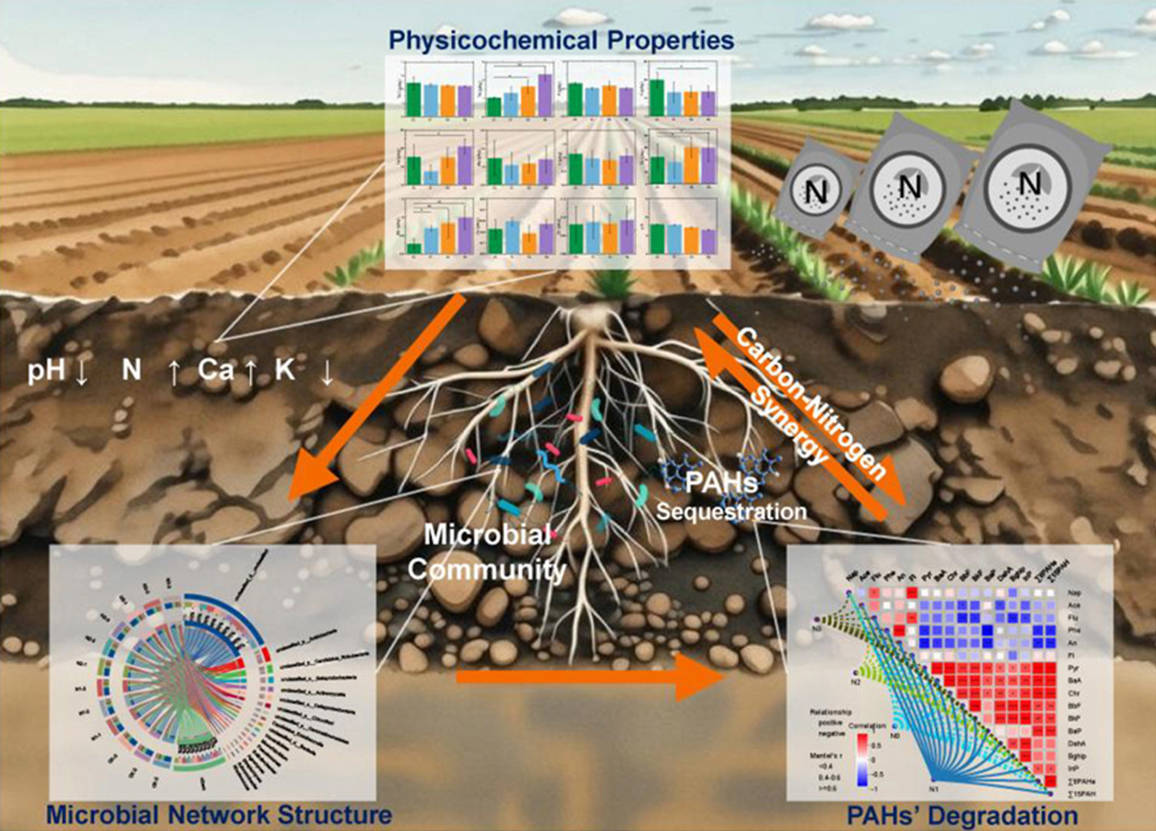
GA, UNITED STATES, November 18, 2026 /EINPresswire.com/ — A 15-year field experiment shows that long-term nitrogen fertilisation reshapes soil microbial networks and their genetic potential for carbon, nitrogen and PAH metabolism. Effects depended on application rate: high nitrogen increased network connectivity, low nitrogen reduced modularity. The authors stress that the findings are association-based and call for site-specific nutrient management that accounts for legacy contaminants.
Nitrogen fertiliser underpins global food production, but decades of application also reshape soil chemistry and the microbial communities that drive nutrient cycling. However, far less is known about how this chronic nitrogen input interacts with legacy organic pollutants — such as polycyclic aromatic hydrocarbons (PAHs) — that persist in arable soils long after their emissions have ceased.
Reporting in the journal Emerging Contaminants, researchers from the Chinese Research Academy of Environmental Sciences and the China University of Mining and Technology analysed surface soil (0–20 cm) from a 15-year field trial comparing four nitrogen application rates. They combined soil physicochemical analysis, shotgun metagenomics, exploratory co-occurrence network reconstruction and residual PAH profiling to ask how sustained nitrogen loading restructures bacterial and fungal communities and their functional potential.
“Experiments of this duration are rare, because most fertiliser trials record yields and nutrient budgets rather than microbial genomes and contaminant residues,” says corresponding author Kunlong Hui.
The treatments left a clear chemical signature: relative to unfertilised controls, total nitrogen and calcium concentrations in the highest-nitrogen plots were 2.25 and 1.38 times higher. “Microbial networks responded differently at different rates,” shares Hui. “Under high nitrogen, average degree — how densely taxa are connected — rose by 15% for bacteria and 31% for fungi; under low nitrogen, network modularity fell by 12% and 30% respectively, pointing to looser, less compartmentalised community organisation.”
Metagenomic profiling associated high nitrogen with a greater relative representation of carbon-metabolism genes and with shifts in the abundance of genes assigned to the PAH-degradation pathway (ko00624). In particular, mantel tests showed that the link between community composition and residual PAH profiles depended on treatment and was strongest under low nitrogen, suggesting that fertiliser regime may influence how tightly the microbiome is coupled to contaminant fate.
“Our results show that long-term nitrogen fertilisation reshapes soil microbial communities and their functional potential for carbon, nitrogen and PAH metabolism,” says Hui. “These are association-based findings: they do not demonstrate pathway activity, PAH degradation rates or altered environmental risk. Measuring actual process rates and contaminant bioavailability is the necessary next step.”
Because the direction and strength of the microbial response depended on application rate, the authors suggested that no single prescription fits every field. “We recommend site-specific nitrogen management that weighs crop nutrient demand against the persistence of residual organic contaminants, rather than treating fertiliser decisions and legacy pollution as separate problems,” says Hui. “Pairing routine nutrient monitoring with metagenomic and residue-based endpoints would give land managers the evidence to do so.”
DOI
10.1016/j.emcon.2026.100732
Original Source URL
https://doi.org/10.1016/j.emcon.2026.100732
Funding information
This work was financially supported by the National Natural Science Foundation of China (Nos. 22308342 and 42030704).
Lucy Wang
BioDesign Research
Legal Disclaimer:
EIN Presswire provides this news content “as is” without warranty of any kind. We do not accept any responsibility or liability
for the accuracy, content, images, videos, licenses, completeness, legality, or reliability of the information contained in this
article. If you have any complaints or copyright issues related to this article, kindly contact the author above.

Media gallery