Thermally Conductive Materials and Automated Dispensing Improve Power Electronics Reliability
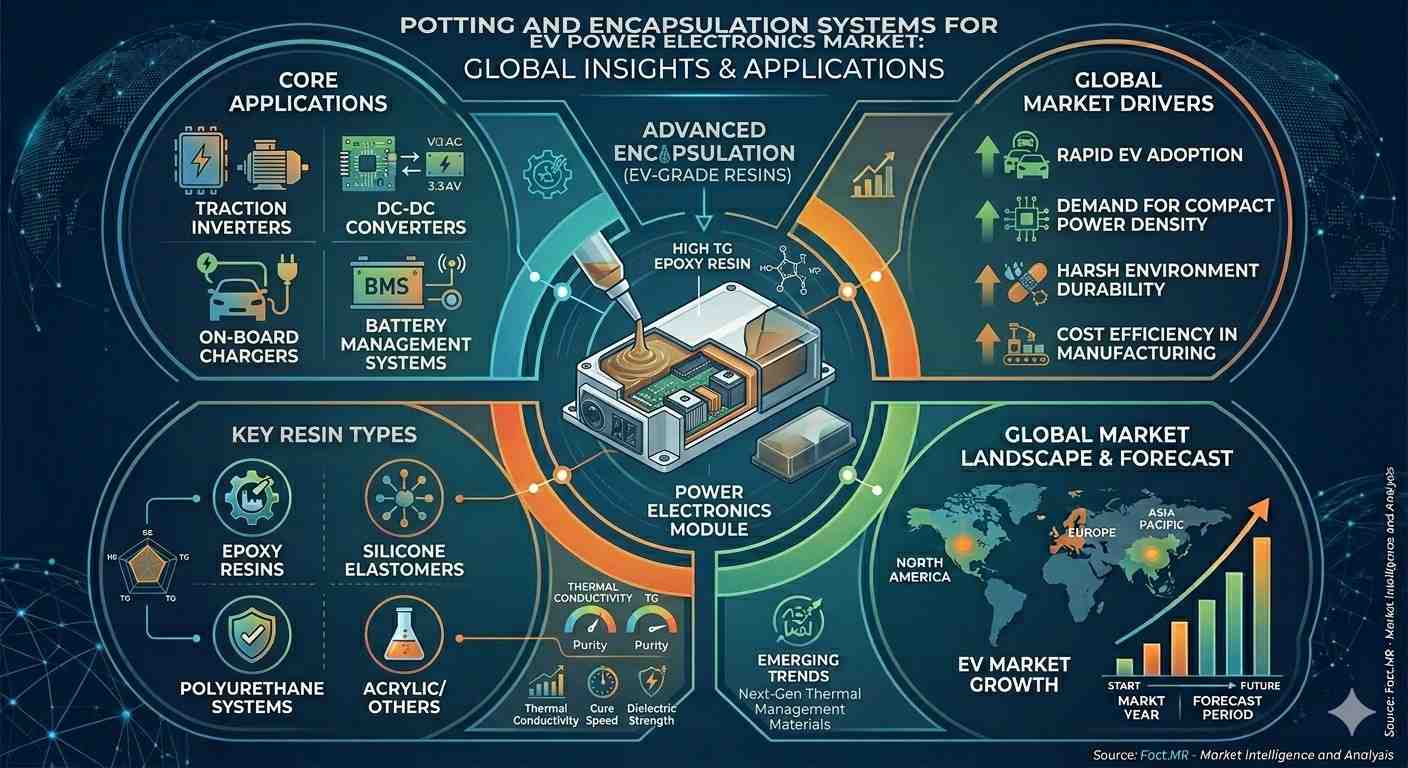
ROCKVILLE, MD, UNITED STATES, April 21, 2026 /EINPresswire.com/ — The Germany potting and encapsulation systems for EV power electronics market is undergoing a transformational growth phase, fueled by the rapid transition to high-voltage architectures and SiC (Silicon Carbide) semiconductor technology. According to the latest market analysis by Fact.MR, the industry reached a valuation of USD 642.8 million in 2025. Demand is estimated to climb to USD 718.5 million in 2026, eventually attaining a forecast value of USD 2,486.7 million by 2036.
With a projected CAGR of 13.5% through 2036, Germany remains a critical center for advanced automotive electronics engineering. The shift is being driven by the National Platform Future of Mobility materials innovation programme, which prioritizes advanced electronic insulation to support the next generation of high-performance electric vehicles.
Get detailed market forecasts, competitive benchmarking, and pricing trends:
https://www.factmr.com/connectus/sample?flag=S&rep_id=14764
Quick Stats: Germany Market Outlook (2026–2036)
Metric
Details
Market Size (2026E)
USD 718.5 Million
Forecast Value (2036F)
USD 2,486.7 Million
Projected CAGR
13.5%
Leading Segment
Automated Dispensing Systems (44% Share)
Dominant Material
Epoxy Resins (39% Share)
Incremental Opportunity
~USD 1.77 Billion
Key German Players
Henkel AG & Co. KGaA, ELANTAS GmbH, Wacker Chemie AG
Executive Insight for Decision Makers
The German market is witnessing a strategic shift as OEMs move away from conventional epoxy encapsulants toward high-performance silicone and hybrid resins. The transition toward Silicon Carbide (SiC) power electronics has increased heat flux density, making thermal management a mission-critical factor for drivetrain reliability.
“In this updated analysis, we observe that industry participants are prioritizing materials that offer both high dielectric strength and superior thermal conductivity,” says Shambhu Nath Jha, Principal Consultant at Fact.MR. “For manufacturers and investors, the mandate is clear: invest in automated dispensing precision and material compatibility with SiC modules. Those failing to adapt to higher temperature resistance standards risk exclusion from the high-growth European EV supply chain.”
Market Dynamics
Key Growth Drivers:
High-Voltage Reliability: Increasing adoption of 800V battery systems requiring superior dielectric protection to prevent partial discharge.
Thermal Management Intensity: The rise of compact inverter designs necessitates advanced potting compounds that act as both an insulator and a heat sink.
Automation Integration: German Tier-1 suppliers are increasingly adopting high-speed automated dispensing to ensure batch-to-batch consistency.
Key Restraints:
Raw Material Volatility: Pricing fluctuations in specialty epoxy and silicone resins can impact manufacturing margins.
Qualification Timelines: Rigorous automotive safety standards (IATF 16949) result in lengthy testing periods for new chemical formulations.
Segment Analysis
System Type: Automated Dispensing Leads
Automated dispensing systems are projected to account for 44% of the market share in 2026. Precision metering is vital for modern assembly lines, ensuring uniform material distribution across complex circuit boards and preventing moisture ingress.
Material: Epoxy Maintains Dominance
Epoxy materials hold a 39% share due to their exceptional mechanical strength and adhesion. However, thermally conductive silicones are the fastest-growing sub-segment, favored for their ability to reduce mechanical stress on sensitive components during extreme thermal cycling.
Supply Chain Analysis (Germany Focus)
The supply chain for German EV electronics is highly integrated and technically demanding:
Raw Material Suppliers: Global chemical giants (e.g., BASF, Evonik) provide the base polymers and fillers.
Manufacturers/Producers: Specialty formulators like Henkel AG and ELANTAS GmbH create the final EV-grade potting compounds.
Distributors: Technical distributors manage the delivery of temperature-sensitive resins to production sites.
End-Users: German OEMs (Volkswagen, BMW, Mercedes-Benz) and Tier-1 suppliers (Bosch, Continental) integrate these systems into inverters and battery management units.
Who Supplies Whom:ELANTAS GmbH recently expanded its production for EV-grade resins to support domestic German power module manufacturers, while Wacker Chemie AG remains a primary supplier of high-grade silicone chemistry to the broader European market.
Regional Analysis: Germany’s 13.5% Growth Trajectory
Germany is Europe’s advanced automotive materials hub. While China (14.3% CAGR) leads in sheer volume, Germany (13.5% CAGR) leads in material engineering and high-performance applications. The German market is characterized by a “quality-first” approach, where material qualification standards are among the strictest in the world, driving value over volume.
Competitive Landscape
The market is moderately concentrated, with German-headquartered firms like Henkel AG and ELANTAS GmbH holding structural advantages through local R&D and deep integration with automotive OEMs.
Key Players: Henkel AG & Co. KGaA, ELANTAS GmbH, Wacker Chemie AG, Dow Inc., and Huntsman Corporation.
Competitive Strategy: Companies are focusing on “fast-cure” technologies to reduce assembly line cycle times and “low-stress” formulations to protect fragile SiC chips.
Strategic Takeaways
For Manufacturers: Focus on dual-purpose materials that provide both vibration damping and high thermal dissipation.
For Investors: Look toward automated dispensing equipment manufacturers that offer “Industry 4.0” connectivity and real-time flow monitoring.
For Marketers: Position products based on “Total Cost of Ownership,” highlighting how better encapsulation reduces warranty claims and increases inverter efficiency.
Future Outlook
The future of the Germany potting and encapsulation market lies in material intelligence. We anticipate the emergence of “smart” encapsulants with embedded sensors or self-healing properties. As EV power densities continue to climb, the encapsulation system will no longer be seen as a “passive box” but as an active component of the vehicle’s thermal and electrical architecture.
Conclusion
The Germany potting and encapsulation systems market is at the heart of the electrification revolution. As power electronics become smaller, hotter, and more powerful, the systems that protect them must become more sophisticated. The USD 2.5 billion opportunity by 2036 represents a major frontier for chemical innovation and automated manufacturing excellence.
Why This Market Matters
Power electronics are the “brain” of the electric vehicle. Without robust potting and encapsulation, these systems would succumb to the harsh environment of the road—vibration, salt, and heat. The reliability of the entire global EV fleet rests on the invisible performance of these protective materials.
Full Report: Unlock 360° insights for strategic decision making and investment planning-
https://www.factmr.com/checkout/14764
To View Related Report:
Demand for Fog Lights in UK https://www.factmr.com/report/united-kingdom-fog-lights-market
Demand for Electric Vehicle Insulation in UK https://www.factmr.com/report/united-kingdom-electric-vehicle-insulation-market
Demand for Automotive Injector Nozzle in UK https://www.factmr.com/report/united-kingdom-automotive-injector-nozzle-market
Demand for Vehicle Anti-theft System in UK https://www.factmr.com/report/united-kingdom-vehicle-anti-theft-system-market
S. N. Jha
Fact.MR
+1 628-251-1583
email us here
Legal Disclaimer:
EIN Presswire provides this news content “as is” without warranty of any kind. We do not accept any responsibility or liability
for the accuracy, content, images, videos, licenses, completeness, legality, or reliability of the information contained in this
article. If you have any complaints or copyright issues related to this article, kindly contact the author above.

Media gallery